

Welcome to the 25th edition of the Analyst of the Month.
Every month, we highlight a leading analyst who takes a long-term view with investing.
This month we highlight Dr. Crossroads.
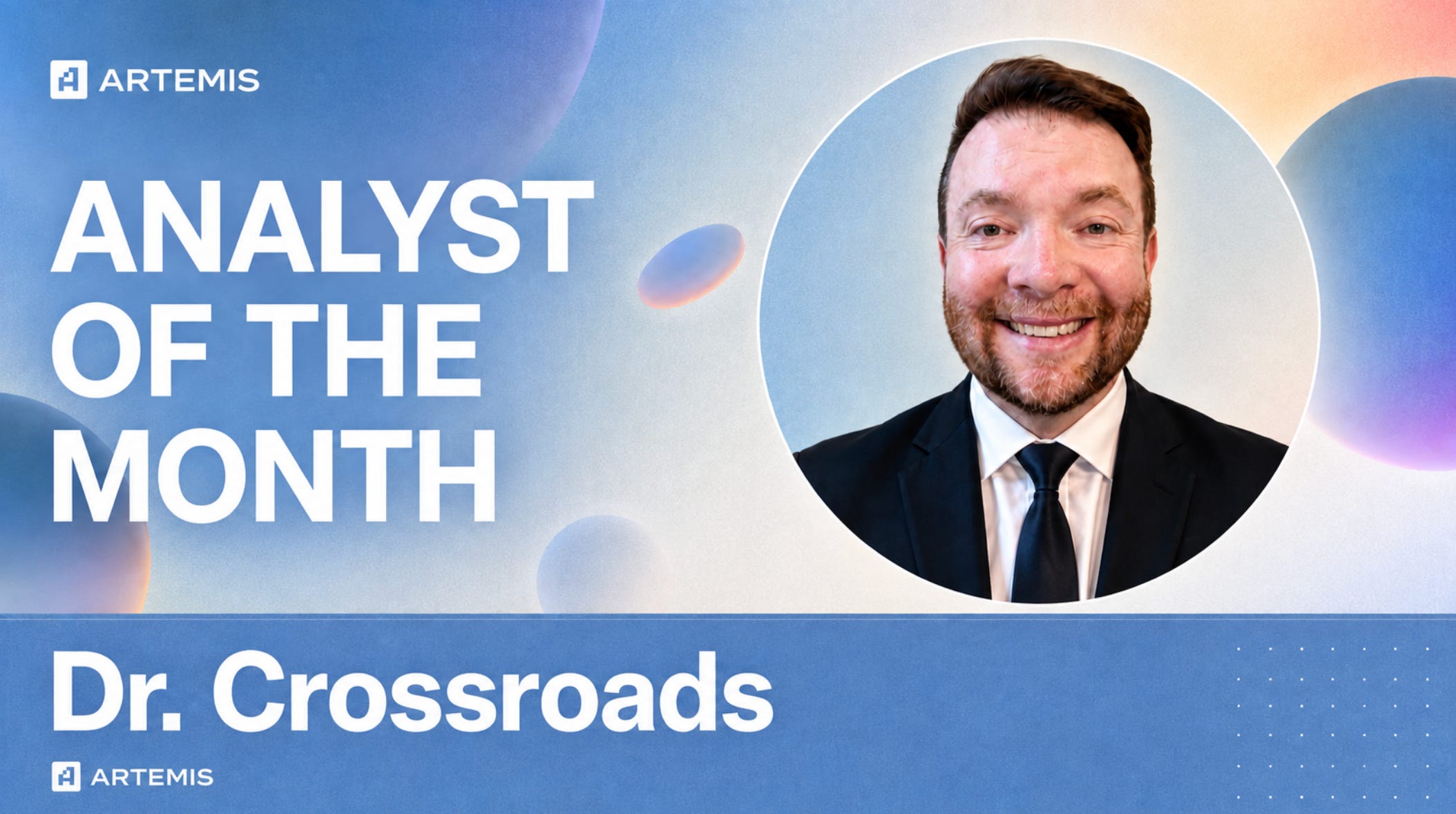
Dr. Crossroads (Roy) is an investor and creator known for deep-dive research across AI, fintech, and emerging technology on YouTube and X.
Roy takes a long-term, concentrated approach to investing, focusing on generational companies, strong leadership teams, and moments when improving fundamentals are still under appreciated by the market. That framework has shaped his investments in names like Palantir, Robinhood, Aehr Test Systems, and Figure.
Read on to learn more about his investing philosophy, how he builds conviction, and why he remains bullish on AI infrastructure and the next generation of financial platforms.
What is your story? How did you get into investing?
When I was 13, my Dad took time to show me his investments and the power of compounded gains over time. These were mostly in broad index funds, and he highlighted the importance of building for the future and that the best advantage I had was time. He talked to me about retirement and how to plan for that (such as the rule of 4%).
I later found out that my great grandfather was an avid investor until the Great Depression, when his gold mine claims amounted to nothing, his cattle stock was struggling, and his stocks had crashed. My grandfather (his son) ended up not investing as a result of seeing his Dad lose almost everything from investing, and as a result he struggled financially with a small pension in retirement.
How would you describe your investment philosophy?
I am primarily a long-term investor, preferring to pay for generational companies at fair prices instead of mediocre ones at cheap prices. If possible, I also like to identify a business whose narrative (which drives short-term price action more than fundamentals) is about to meaningfully shift. While I also do some swing trading, I find the long-term mindset works best when I’ve picked companies that are going to perform well no matter what the macro throws their way. This doesn’t mean the stock always goes up, but that the company continues to execute and grow in challenging conditions.
A significant part of my investment thesis is leadership. While some investors are happiest buying a company that a paperweight could effectively run, we’ve seen how “safe” companies that appear to have a strong moat are being disrupted in unprecedented ways due to shifting technology. As just one recent example, we have had the so-called SaaSpocalypse this year, as companies that were once deemed safe with deep moats are now viewed in a more skeptical lens due to the advent of AI. It’s here that leadership is essential.
A paperweight wouldn’t help pivot a company successfully. An elite leadership team would.
There’s a range of criteria I use to evaluate leadership, from whether or not they were able to keep past promises, to their tendency to chase shiny objects instead of focusing on the business core. I also look at whether leadership is proactive vs reactive in their business decisions, their past successes, if they’re overly focused on the stock vs what they are building, and how they treat shareholder capital.
What has been one of your best investments? How did you build conviction in deciding to invest?
While I invested in index funds earlier, I began investing in individual equities at the start of 2021. My first monetary success was via the AMC squeeze event, where I did roughly a 4x in a few months and took profit accordingly. In terms of best actual investments, those include Palantir, Robinhood, and Aehr Test Systems.
I began buying PLTR in January 2021. I had observed at my workplace the disfunctional, disorganized state of enterprise software, and Palantir seemed to have what would be very disruptive in the space with Foundry on top of their government segment. I ended up being early. Palantir, like most high-flying stocks, retraced immensely in 2022. Prior to and during 2022, I realized Palantir had what it took to be a generational company, and as such I rotated 90% of my individual investments into this one stock, averaging down to $12 per share and buying a number of LEAP options.
While I still hold Palantir as a top 5 position, I took many gains along the way. Some of these gains fueled my next 10x investment: Robinhood, which was trading at a 1x EV at the time, with a large cash position and no debt, much like Palantir. I looked at the narrative and realized a “golden confluence” moment was about to occur in this cyclical business, with high interest rates, the start of a bull market, and the crypto bull market. At the time, I thought of Robinhood as an excellent swing trade. Over time, as I saw Vlad and his team execute relentlessly, I realized I had stumbled on another generational opportunity and it became a long-term position for me.
I’ve had quite a few other successes along the way, with AEHR being a major success for me this year. Again, the setup was clear. Aehr was shifting from 90% SiC revenue for their wafer and package level burn in testing equipment offerings to something more durable with the advent of AI and the significantly higher cost of failure of GPUs (and other components), along with the need for increased throughput via WLBI testing. The company had no debt, was in the process of a major accretive acquisition, and the CEO was incredibly knowledgeable in the space, with only one major misstep (related to EVs and renewables). The narrative shifted first, followed by comments on bookings, then bookings and finally the beginning of the revenue acceleration. I believe this will be my next 10x, with an average in the low $20’s.
With each of these, the investment thesis was initially basic, but by following announcements, quarterly earnings, and trends in their space my conviction increased even as their execution improved. It made each easy to hold through volatility as they relentlessly execute.
You recently wrote about Hyperscaler Earnings and the signal on AI. What is your thesis moving forward on the AI investment bottleneck stack?
We’re still dramatically underestimating the demand for data inference related to the AI trade, and the debt for these CapEx buildouts is (mostly) not scary when balanced against take-or-pay contract structures. Simply put, there’s a lot of negativity priced into data centers at the moment, yet there is insatiable demand which looks to be durable at least through 2030, if not beyond.
That said, there are dozens of ways to play this AI trade, and I think most are still in the early innings, from storage, to memory, to data centers, to automated testing equipment, power, cooling, enterprise software, cybersecurity, and more. If someone wants exposure, it’s important to find just a couple of themes investors can understand and are interested in, and find the winners in that space.
There are some parts of the AI trade that have such immense returns that we’ll see many new entries into the market to sate demand. We saw that with hyperscalers developing their ASICs, with many companies pivoting to data center businesses, and most recently within storage and memory. The challenge is that many of these projects take years and significant investment to get off the ground. As such, I prefer to concentrate on the leaders in the space unless it’s clear that disruption is warranted or if the leader isn’t executing well. Even as new entries come online, the TAM is larger than most realize, and companies who are led well might at worst see a smaller market share of a much larger pie.
You work full time, hold a PhD and are a finance creator and influencer! How did you get to where you are today?
I figure that the time will pass regardless, so it might as well pass while building things I love and working towards a direction I’d like to be in the future. Aside from one area in my life, I’ve had more success than I imagined, but I don’t let success go to my head or stop me from growing.
Some of these opportunities came even when I wasn’t expecting them, but what made many of them possible is being consistent: creating content, providing value, doing research, examining the other side of a thesis, and finding enough flexibility to pursue new opportunities.
My faith has been a benefit in that I don’t view success by a number on the screen (whether followers, income, or net worth), but by faithfulness. As such, I’m not willing to compromise character or shortchange an important relationship for financial gain or personal benefit. Over the short-term, that has cost me some opportunities. Over the long-term, I think it’s benefitted me in both qualitative and quantitative ways.
What advice do you have for investors who are beginning to invest in 2026?
2026 has been another rollercoaster market. That’s likely to continue through the rest of Trump’s term. During the downturns, don’t give up on the market. Instead, use that as a barometer for how much volatility you’re really okay with. Concentrate in just a few high quality names and learn everything you can about them. If the thesis weakens, don’t be afraid to pivot, but be careful about chasing green candles and shiny new objects.
Lastly, “boring” investing can be very successful. If the volatility is too much, especially if you are young, there’s nothing wrong with just investing in an index fund and focusing your time and energy into earning more. That’s largely what I did until 2021.
What’s your thesis for FIGR 0.00%↑ ?
The simple thesis for Figure Technologies: there are few companies who are equally adept at TradFi and cryptocurrency. They’ve built something special with HELOCS, but this was just the first step in their vision. They’re able to leverage incredible efficiencies that almost nobody can compete with, and do so as a platform which invites participation from competition.
Although the “year of first lien” is largely being ignored by the market due to the moribund state of real estate, and this likely worsens for 3-6 months following the election, this is the perfect time to build and prepare for future volume that will come. Current conditions make it tough for competition, and Figure is incredibly well-positioned for an eventual thaw in this market, but even without the thaw, they’re growing 100% Y/Y and many of their offerings benefit from higher rates.
What’s your most contrarian view on the markets right now?
Back in 2023, I said we’re likely to be in a durable bull market through 2029 or 2030, due to how much of an impact AI (with robotics behind it) will have on our economy. That’s no longer contrarian.
Over the last year, I was one of a vocal minority saying that we were not in a bubble (except with private equity). That no longer appears to be contrarian.
Today, the most contrarian take I have is one that should be obvious: CapEx buildouts, even when fueled by debt, should be seen as bullish when done by credible companies and leadership teams. These are being done by some of the most successful companies and leadership teams, and even by some which are incredibly conservative (such as TSMC).
How have you been able to use Artemis in your investment research process?
I’ve really enjoyed using the Analyst feature, especially as this has evolved, to create charts and pull quotes from recent interviews and earnings calls. It’s also been great at quantifying some trends that I’ve sensed, but wasn’t able to put concrete numbers on. Additionally, I like being able to track elements of my investing portfolio on Artemis, including the Robinhood Chain, Rothera / Predictions markets, Figure Technologies blockchain metrics, and stablecoin activities for several investments.