

Welcome to the 28th edition of Analyst of the Month.
Every month, we highlight a leading analyst who takes a long-term view with investing.
This month we highlight Mario Stefanidis at North Island Ventures
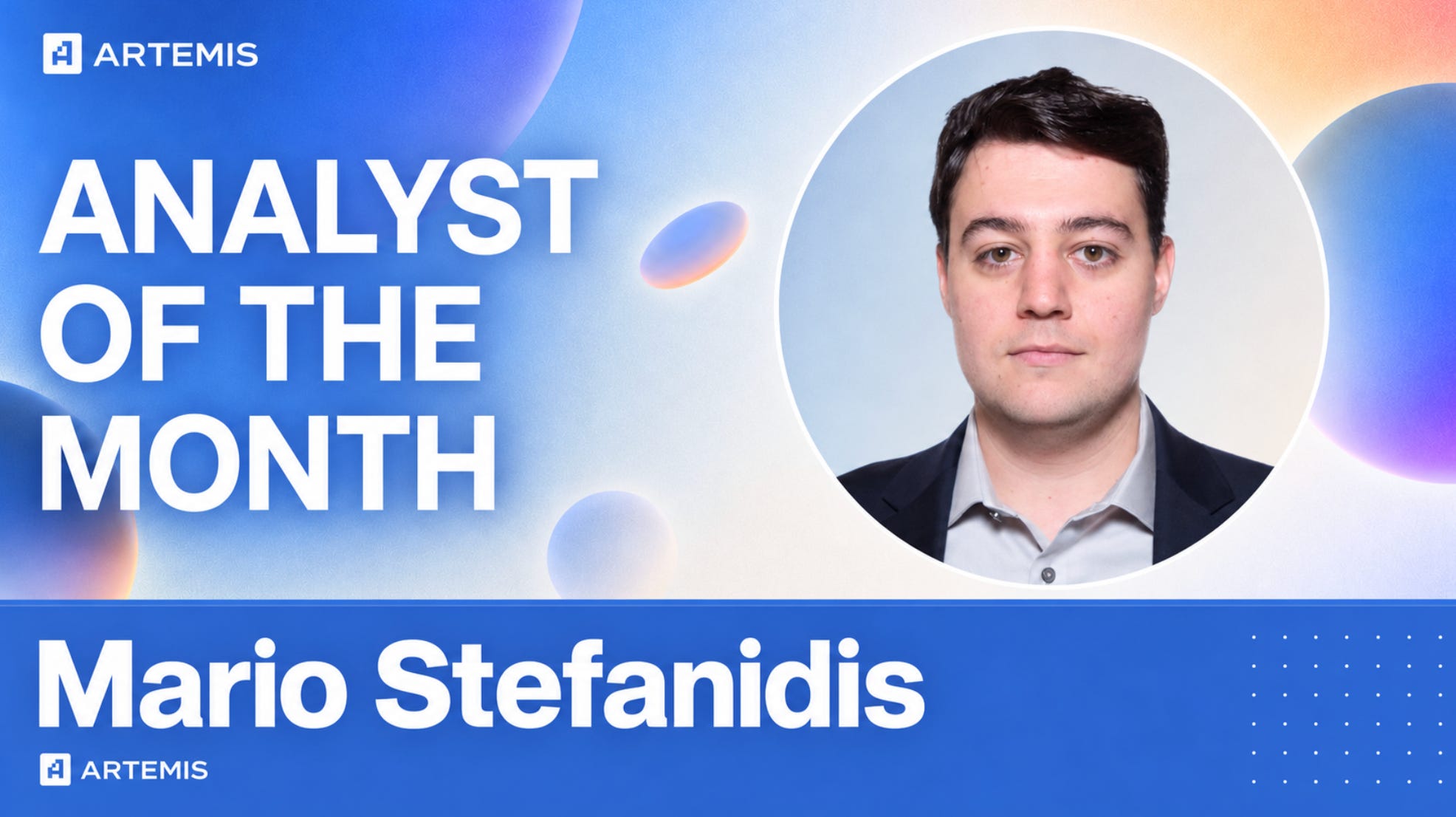
Mario Stefanidis is an investor at North Island Ventures, where he focuses on public equities across fintech, AI, and crypto.
His path to investing started unusually early. As a teenager, Mario became one of the largest traders in Team Fortress 2’s virtual economy, eventually adopting Bitcoin in 2012 to facilitate transactions. He later began his professional career at BlackRock, helped build thematic investment products at Roundhill Investments, studied value investing at Columbia Business School, and joined Artemis before ultimately moving to the buy side at North Island Ventures.
Read on to learn more about Mario’s path from virtual economies to public-market investing, why he believes classification errors can create some of the biggest opportunities in markets, and how he approaches finding mispriced businesses across fintech and crypto.
1. What is your story? How did you get into investing, and what took you from BlackRock to thematic investing at Roundhill, crypto and tech stock research at Artemis, and ultimately the buy side at North Island Ventures?
My dad got me into investing from a very young age. I was probably six when he opened me a savings account at our local bank in Douglaston, Queens. Every time I’d get money from relatives for birthdays, name days, Easter, Christmas, etc. I’d deposit most of it in the account. He taught me the importance of saving and compounding, and the 2000s were a time when CDs allowed you to compound at good interest rates.
The other part of the backstory is that I’ve always been a gamer. In 2007 I started playing a game called Team Fortress 2 on PC, sinking over a thousand hours in the team-based shooter. That game ended up becoming the primary reason there is a virtual economy. TF2 was the first game to introduce microtransactions at scale, primarily through digital cosmetic items like hats, earbuds, and other accessories for your character (I wrote about this topic at Roundhill in 2020). You got these items through opening lootboxes with $2.49 keys bought directly from Valve – at the time completely novel, now prevalent across video games. I lucked out when I became addicted to TF2, because it’s the reason I am an investor today.
I used the money I’d saved from when I was 6 to become one of the largest traders in TF2 by 14. I bought and sold various items for a spread, warehousing thousands of dollars of inventory as a trusted vendor with a lot of “rep,” which is how customers vouched for you on your Steam profile or on trading forums. I sourced digital merchandise myself and eventually through a network of brokers. I started using PayPal, but then to eliminate the risk of fraudulent chargebacks and lower fees, as well as abide by a new prohibition on digital goods transactions, I switched to Bitcoin in 2012. This entailed convincing my parents to let me buy some on Coinbase with their credit card. I was probably one of the first thousand Coinbase customers. I’d try and turn over the cosmetics that day, before the price could move against me, to a growing list of clients. I ended up doing this for about five years, until I started college and my priorities shifted.
I joined BlackRock as an analyst on the fixed income strategy team in San Francisco in 2017, under the iShares umbrella. I chose BlackRock for two reasons – one, the firm offered the best resources to learn the ins and outs of investment management for a 22-year-old, and two, because fixed income ETFs were growing like a weed and were still way underpenetrated as a proportion of the bond market. I also had a great professor at Fordham who really got me into the asset class.
By August 2020 I was at BLK for three years, and wanted to do something more entrepreneurial, having built some experience as an analyst and associate at a large firm. I was still also very passionate about gaming. One day on LinkedIn, I saw a job posting for a research associate at Roundhill Investments, at the time a $200M subscale ETF manager with two products – one of which was a gaming fund. A marketing associate and I joined the two cofounders in a journey that saw us push the envelope of what was possible in the ETF wrapper, while sticking to thematic investing in innovative sectors like streaming and the metaverse. This included one of the first pitches to the SEC on crypto in a 40-Act wrapper. The team grew from the four of us to eight, and AUM from $200M to $1.4B.
2022 ended up being a really challenging year for tech and crypto – no surprise to Artemis’ tech-forward audience. Amidst a 60%+ drawdown in AUM the firm pivoted directions, which led to me joining Columbia Business School in September 2023. At CBS I joined the Value Investing Program, to become a better investor and more disciplined on valuation. The program was also a bucket list item of mine for a while, as I’d been going to the Berkshire shareholder meetings in Omaha since 2017. During B-school I spent 6 months at a value oriented, cross-capital structure, special situations hedge fund called DG Capital.
I graduated CBS in 2025 and joined Artemis that October, again combining the tech and crypto thread I’d been pulling since I was a teenager with the valuation discipline Columbia had drilled into me. I thoroughly enjoyed my time at Artemis, as I had the autonomy to write about the stocks and themes I was interested into a large audience of retail, and increasingly institutional, investors. Artemis illuminated for me how misunderstood certain “crypto-linked equities” were, sporting high betas to Bitcoin despite not relying on crypto token prices to stay healthy businesses.
The crypto bear market led to a massive dislocation in the market and all-time high dispersion. I joined North Island Ventures (NIV), a NYC-based investment firm focused on innovation in public and private markets, in May, to invest in these opportunities. I am currently focused on public equities in fintech, AI, and crypto; in my opinion the delta between intrinsic value and market price for some of these stocks has never been higher. The team at Artemis maintains a close professional relationship with NIV and we’ve published two pieces since I joined, one on HOOD and one on FIGR.
2. You’ve gone from helping build thematic investment products to doing much more concentrated, fundamentals-driven investing. How has your investment framework changed along the way?
What my former experiences taught me were that the ETF wrapper is an excellent way to deliver exposure and a poor way to express conviction.
First, there is a mechanical constraint in the ‘40 Act wrapper. While most ETFs register as non-diversified, to keep favorable tax treatment, your fund has to pass a diversification test at the close every quarter: no single issuer above 25% of total assets, and across half the portfolio, no position above 5%. So even a fund that is concentrated in ETF terms still can’t concentrate its book into its best ideas. Issuers have gotten inventive about this in the last few years, through derivative overlays, Treasury collateral, single-stock structures, etc.
The other problem is that an ETF has no control over its own capital. It is continuously offered, daily liquid, and permanently fully invested. Flows arrive when a theme is beloved and leave when it’s hated, which means the vehicle mechanically buys high and sells low regardless of the quality of the underlying analysis. In 2022 I watched our actively managed streaming ETF SUBZ fall 50% in price and shed an additional 50% of its assets through outflows. NFLX was our biggest holding, and the cleanest expression of the streaming theme, but we couldn’t hold a concentrated position. Instead, we took outsized losses on lower quality names we had to hold for diversification requirements.
What I love about NIV is that we we are never forced buyers or sellers of any security. We’re able to hold both crypto and stocks, and generally aren’t bound by regulatory position sizing limits. In essence, we can meaningfully concentrate in our highest conviction opportunities.
Where I look hasn’t really changed. We concentrate on the sectors rebuilding financial infrastructure — exchanges, payments, on-chain trading and lending, high performance computing, to name a few. For some of our names, the analyst base is thin and split between crypto people who don’t read income statements and financials people who don’t understand the rails, so almost nobody is underwriting both. “Digital Assets” teams at big banks and asset managers are still nascent, and we want to be there before these names re-rate. It is a brave new world out there.
Our investing style is heavily driven by fundamentals. Every opportunity is thoroughly modeled, written up, and passes stress testing at IC. We use AI to discover things in financial statements, earnings presentations, transcripts etc. that may have been overlooked by the Street. We’ve built our own dashboards to discover opportunities and monitor existing positions using alternative data. Our ideal holding period is for years but we are willing to quickly change our minds if the thesis changes, which I think is a real edge in this high dispersion, high volatility regime. Our small team size allows us to be really nimble.
One thing I did keep from the ETF years: I understand flows in a way most fundamental analysts don’t. I know who the marginal buyer of a thematic name actually is, how creation and redemption work, why premiums and discounts open up and when they close. And in crypto, which went from being banned in the ETF wrapper to BlackRock’s biggest product in two years, this dynamic matters.
3. You’re now focused on fintech and crypto-linked public equities. How do you underwrite those businesses differently from a traditional financial or software company? What are the few variables that tend to matter most to you?
I underwrite fintech and crypto-linked equities as hybrid businesses, rather than forcing them into a traditional bank or software framework. The key is separating durable earnings power from market-cycle beta, and evaluating how much growth comes from customer adoption and share gains versus crypto prices, trading volumes, or funding conditions.
A bank uses equity capital to support a much larger balance sheet of loans and securities, and regulators limit how much it can lend relative to that capital. Return on equity (ROE) therefore tells you how much profit the bank generates for each dollar of capital it must retain. The key question is whether its normalized ROE exceeds its cost of equity without taking excessive credit or liquidity risk.
For many fintechs, ROE is less useful because they are transaction or software businesses rather than balance-sheet businesses. Their book equity may be distorted by accumulated losses, stock compensation, excess cash, acquisitions, or intangible assets. A highly efficient payments company could have very little book equity and therefore an artificially high ROE, even though ROE says little about its underlying economics.
The variables I focus on most are normalized activity and take rate, GPV/volume growth, contribution margins after incentives, losses, and compliance costs, regulatory durability, and free cash flow conversion. I also stress-test the model across different market environments because these businesses often have much more operating leverage and reflexivity than traditional financials or software companies. Ultimately, I want to know whether the company is building a durable network or simply monetizing a favorable cycle.
4. What is your most contrarian view across fintech, crypto, or public equities right now? Where do you think consensus is most clearly wrong?
Figure Technology (FIGR) is one of the most misunderstood names I’ve come across, which is why I’ve now written it up twice, most recently with Artemis here. The company spent six years building one of the fastest and cheapest home equity lender in the country, and Figure Connect is the marketplace where third-party originators trade loans.
While I can’t opine more on specific names, the market is also wrong in treating crypto-linked equities as beta vehicles, while most aren’t. During times of volatility – both to the upside and downside – correlations among these handful of spikes off Bitcoin, despite not having a material impact on the underlying business. The tell is that correlation to the operating peer group doesn’t move at all in those windows. If the business were genuinely impaired you’d expect it to trade with its comps.
5. What is one question you wish investors asked more often?
“Is this a forecasting error or a classification error?”
Most people looking for mispricing are looking for forecasting errors, trying to find where the market has the wrong number. Those are hard to find and get competed away fast. Classification errors are different: the market has the right numbers and the wrong category, so it applies the wrong multiple to a perfectly accurate model. Those persist for years, because nothing in a screen catches them.
6. Having worked inside Artemis and now using data from the perspective of a buy-side investor, how do you use Artemis in your research process today?
I use Artemis primarily for crypto, prediction markets, perps, and DATs data, and continue to believe Artemis is the best data provider in the space. Since the platform’s transition to thesis-driven investing, I also find myself reading the articles posted by investors across crypto and stocks. Artemis’ Analyst product is excellent - it allows me to pull any financial metric or KPI for any company historically, or see what the consensus estimate is. The visualization is really good, particularly when it creates comp tables. Lastly but not least, since it has all of this warehoused data, it can quickly put together a realistic base/bull/bear case for any company, which lets me judge whether to dive deeper with fundamental research.
7. How can people follow your research and get in contact with you?
The best way is on X - my handle is @covered_call. You can also reach out to me on Telegram @mssNIV or by email mario@northisland.ventures.
The opinions expressed in this piece are solely my own and do not express the views or opinions of North Island Ventures (“NIV”) or any company with whom NIV is affiliated. This is not an offer to buy, sell, or solicit securities, nor should you rely on anything I’ve written as legal, financial, accounting, investment, tax, or any other kind of regulated advice or endorsement of any product.
.