

Agentic commerce is the least underwritten part of the Coinbase thesis, and potentially the most important. It is early, speculative, and hard to model, but that is exactly why the upside is so asymmetric.
Agents are one of those platform shifts where the first-order use case is obvious, but the second- and third-order effects are impossible to predict. That uncertainty is precisely the investment case. Coinbase has a track record of entering frontier markets early (crypto, stablecoins), absorbing the initial ambiguity, and turning emerging primitives into scaled revenue lines.
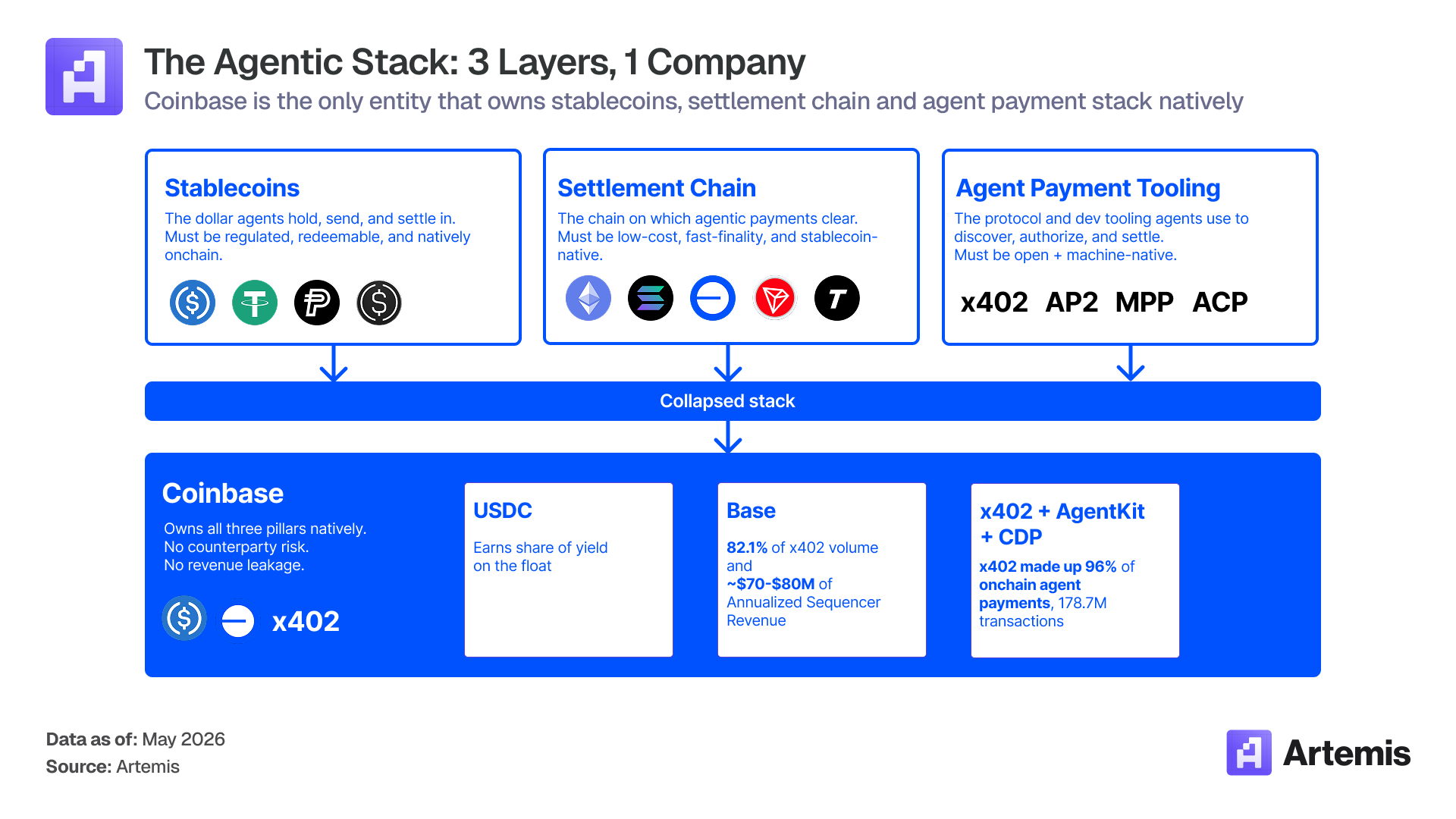
For agentic commerce, the same pattern has formed: Coinbase has exposure to the stablecoin, the settlement layer, and the agent payment protocol that every credible path likely depends on.
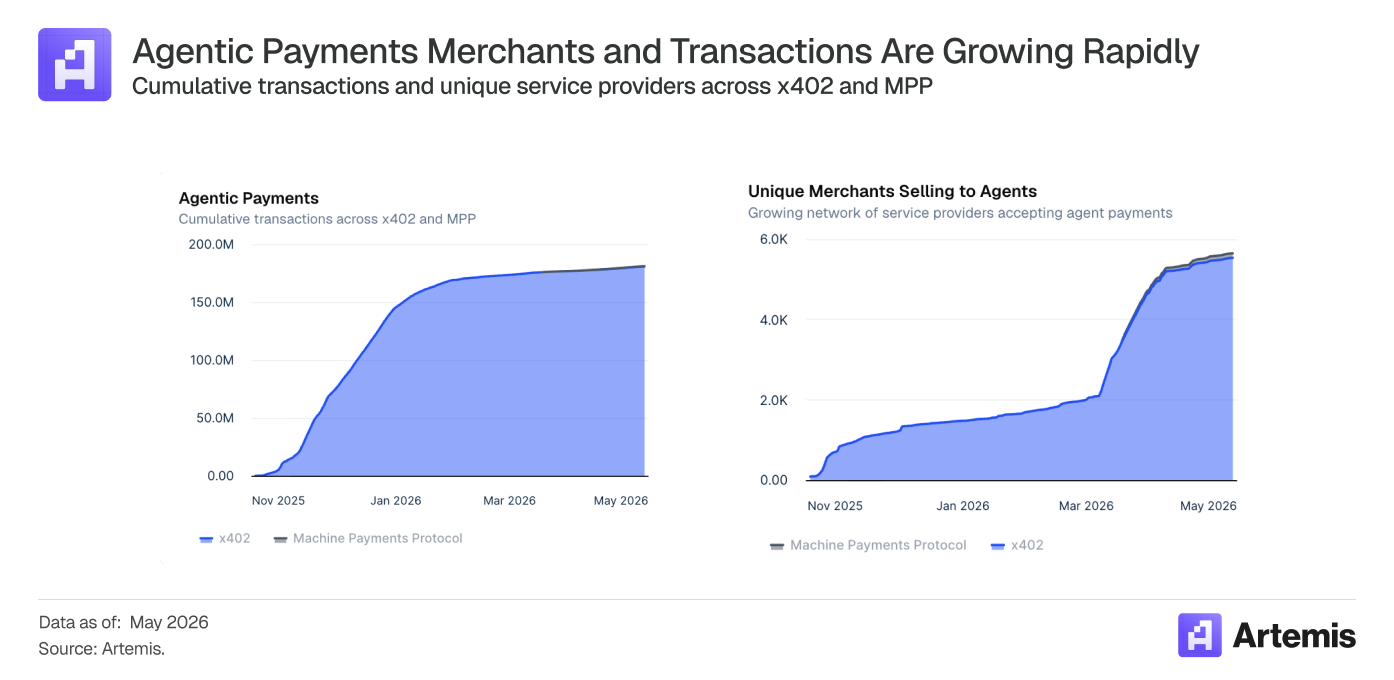
Having already crossed $300 billion in supply, stablecoin growth represents a significant earnings vector for Coinbase through 2030 and beyond. The question is no longer whether stablecoins can reach mainstream scale, but what drives the next phase of growth. Agentic commerce could become that driver by creating an entirely new market dependent on stablecoins.
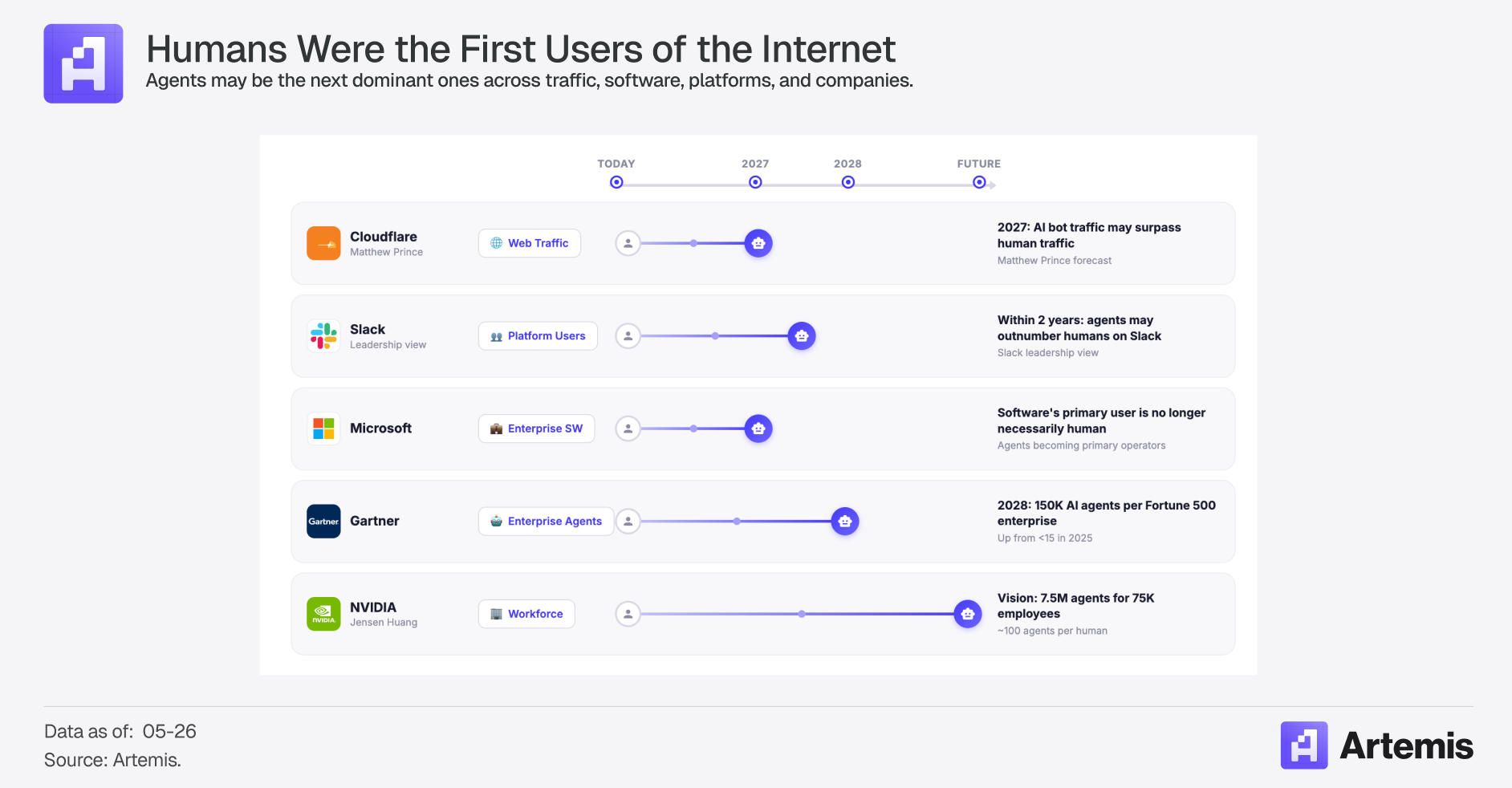
Agents are becoming a new class of internet user, company worker, buyer, and economic actor. Cloudflare expects AI bot traffic to surpass human traffic by 2027, Slack expects agents to outnumber humans on its platform within two years, Microsoft sees software users shifting beyond humans, and Jensen Huang has described Nvidia operating with 7.5 million agents for 75,000 employees.
Economic actors need money. AI agents will buy APIs, data, compute, inference, software, and services in real time. These payments will be high-frequency, small-dollar, global, and automated. Card rails were not set up for this: a $0.03–$0.04 fixed cost makes a $0.003 API call uneconomical, while stablecoins on blockchains can settle in seconds for fractions of a cent.
If agents become a primary user of the internet, they need three things:
A programmable unit of exchange
A low-cost settlement layer
Developer infrastructure to hold balances, authorize spend, manage permissions, and transact without a human in the loop
Coinbase already has built all three:
USDC as the programmable dollar
Base as the low-cost settlement layer
CDP / AgentKit / x402 as the developer and payment infrastructure stack
Coinbase is not the only company building for this. Stripe’s Machine Payments Protocol, Visa’s agent pilots, Circle’s Agent Stack, PayPal’s PYUSD-backed efforts are all credible. The difference is vertical integration: Stripe is anchored to card rails and its stablecoin position is still young; Visa and Mastercard face unit economics that don’t work below a cent; Circle has the stablecoin, but the chain is not yet live, and the developer ecosystem is more nascent; PayPal has the stablecoin but not the chain or the developer surface. Coinbase is the only player with issuance economics, a settlement layer, and a payment protocol under one roof, which is what allows USDC, Base, and x402 to compound on each other.
Coinbase’s stack is now starting to move into enterprise distribution. Coinbase recently announced that x402 and Coinbase wallet infrastructure are now integrated into Amazon Bedrock AgentCore Payments, AWS’s agentic payments product. This matters because it gives AWS developers a managed way to let agents discover services, pay in USDC, and transact with budget controls, compliance, and audit trails. For Coinbase, the bigger signal is enterprise validation.
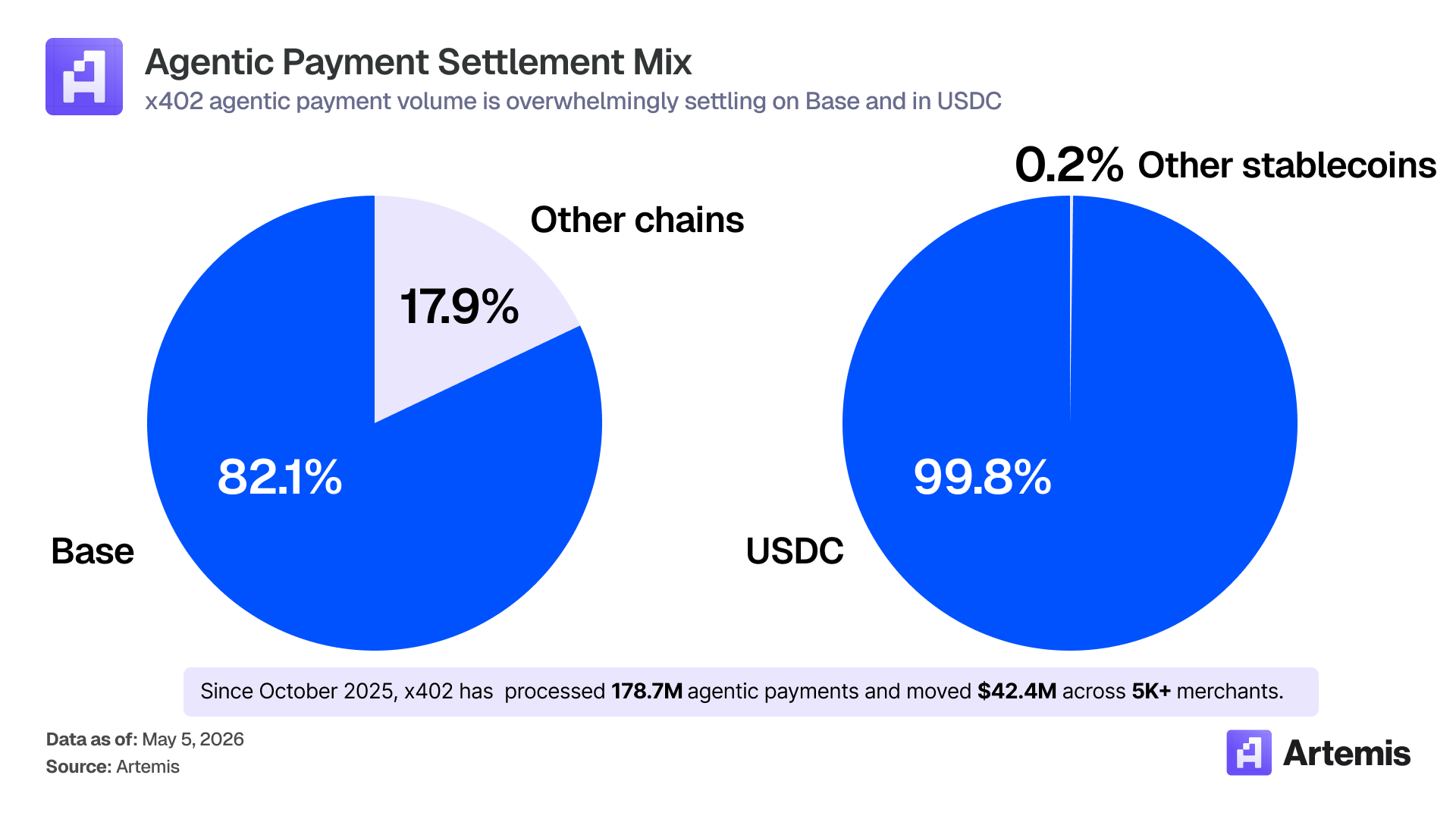
This distribution milestone comes on top of early x402 protocol traction. Since October 2025, x402 has processed 178.7 million agentic payments, moving $42.4 million in agent spend across more than 5,000 merchants. Of that volume, 82.1% settled on Base and 99.8% settled in USDC. Right now, early agentic payments activity is defaulting to Coinbase in the form of Base, USDC, and x402.
Coinbase’s economic exposure is not limited to transaction fees. The larger opportunity is becoming the financial account layer for autonomous commerce.
The agentic bull case for Coinbase is material:
If agentic commerce reaches $7.5 trillion in annual volume by 2031, in line with the high end of McKinsey’s estimate, and 20% settles through stablecoin rails, this implies $1.5 trillion of annual stablecoin-based agentic payment volume.
If Coinbase compounds on its early lead, it could capture roughly $4.25 billion of annual revenue from USDC float, developer infrastructure, facilitator economics, and Base settlement.
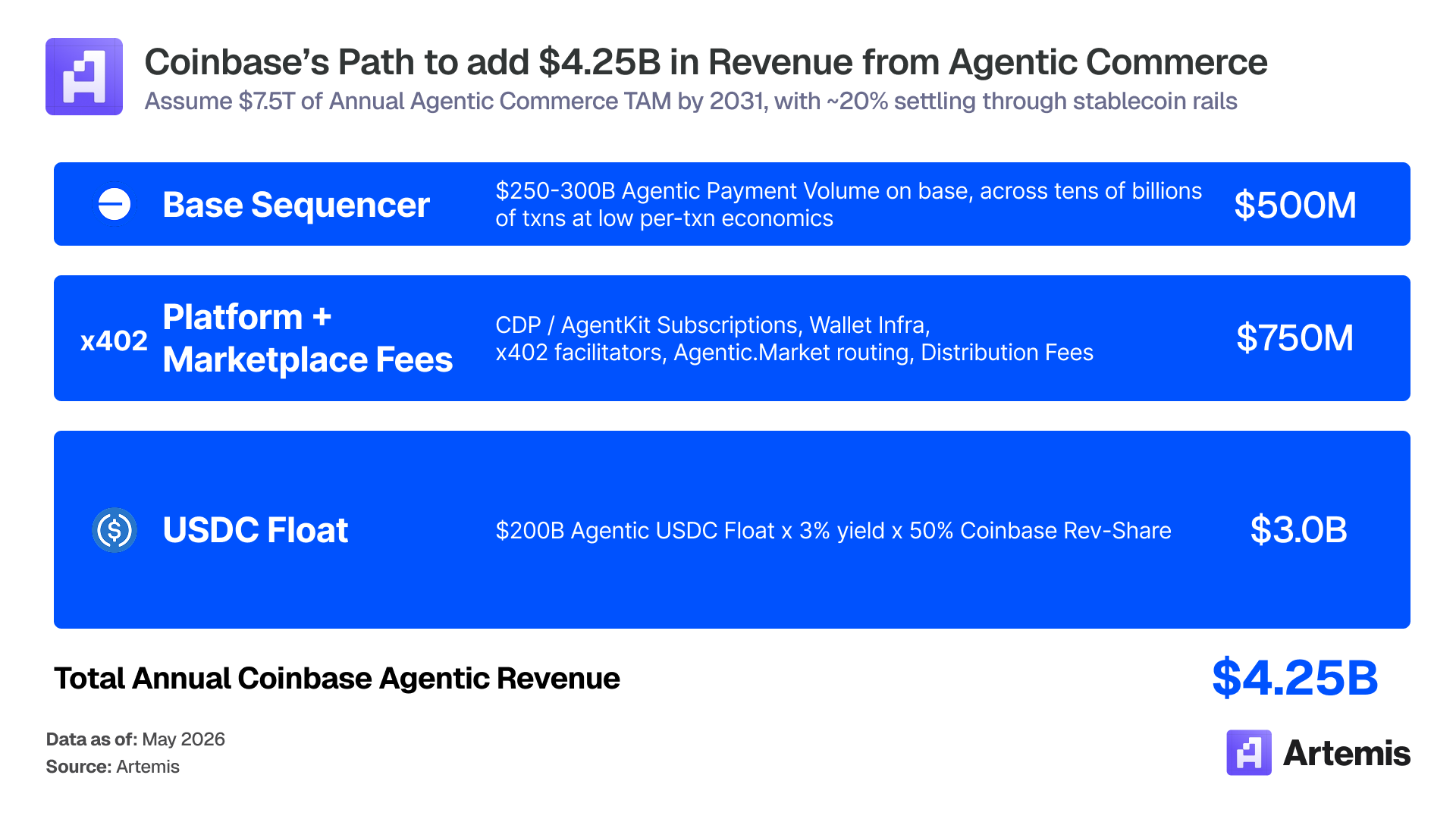
The key point is simple: stablecoins gave the internet a payment layer. AI agents may give that payment layer its first native 24/7/365 user base.
If stablecoins are the monetary layer of internet-native finance, agentic commerce is one of the clearest reasons that layer compounds. And if agents become the next major user of the internet, Coinbase is positioned to own the financial stack they use to hold, route, and settle money.
Our view: the market is still underwriting Coinbase as a crypto exchange. It should be underwriting Coinbase as financial infrastructure for AI-native finance.
Disclosure: This material is provided for informational purposes only and does not constitute investment advice, financial advice, trading advice, or any other form of advice. The views expressed are those of the authors and should not be relied upon as a recommendation to buy, sell, or hold any asset. The authors or affiliated entities may hold positions in the assets discussed. You should conduct your own research and consult appropriate financial professionals before making any investment decisions