

Last week we had Lorenzo Valente from ARK Invest on the podcast to discuss why Circle is under-appreciated by the market. We extend that thinking in this week’s Thesis.
Thesis: The market thinks Circle’s moats are weak, stablecoins are a commodity, and a consortium like Open Standard will take a majority share. We believe Circle’s moats are deeper and more defensible than they get credit for, and the first-mover advantage is being under-appreciated by the market.
Core drivers:
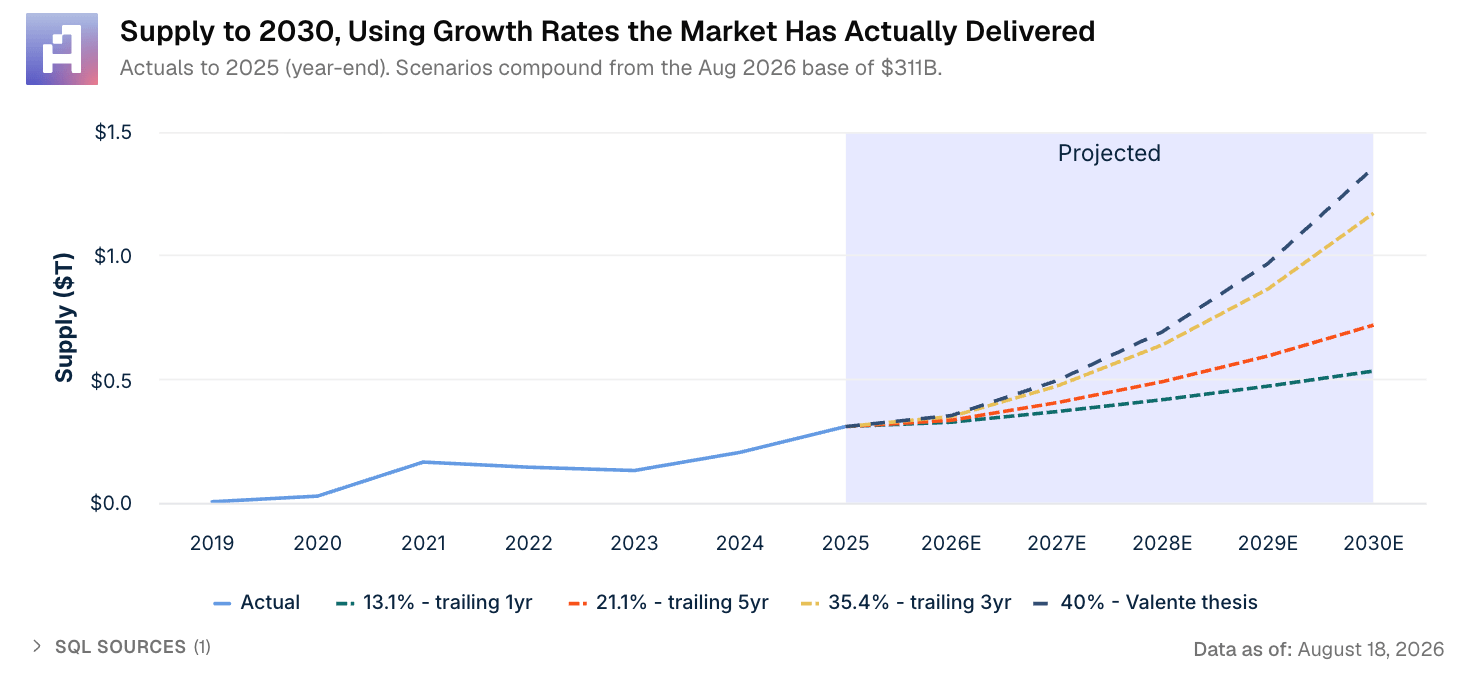
Stablecoins will CAGR at 40% and reach >$1T by 2030.
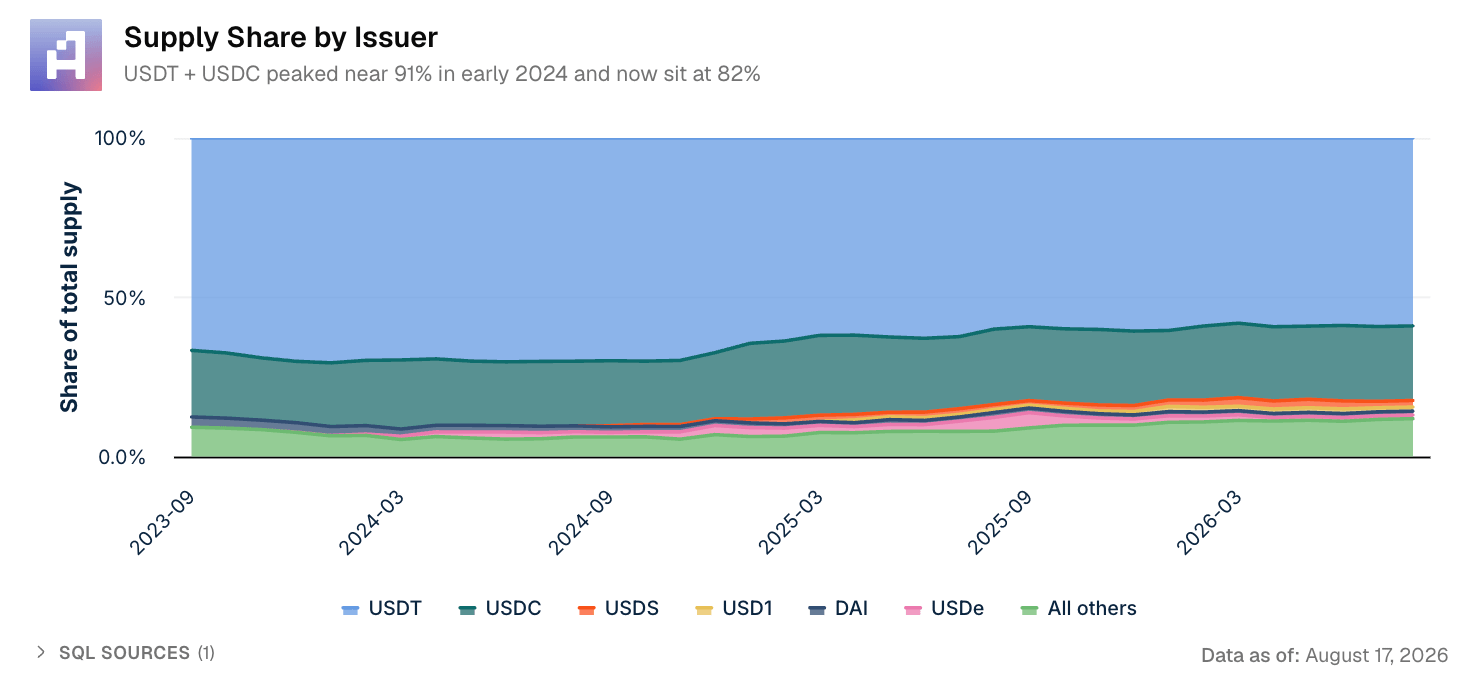
The market is winner-takes-most on liquidity and network effects so a consortium like OUSD will struggle to take share.
Circle is being priced as a stablecoin issuer instead of a full-stack money platform.
Why now?
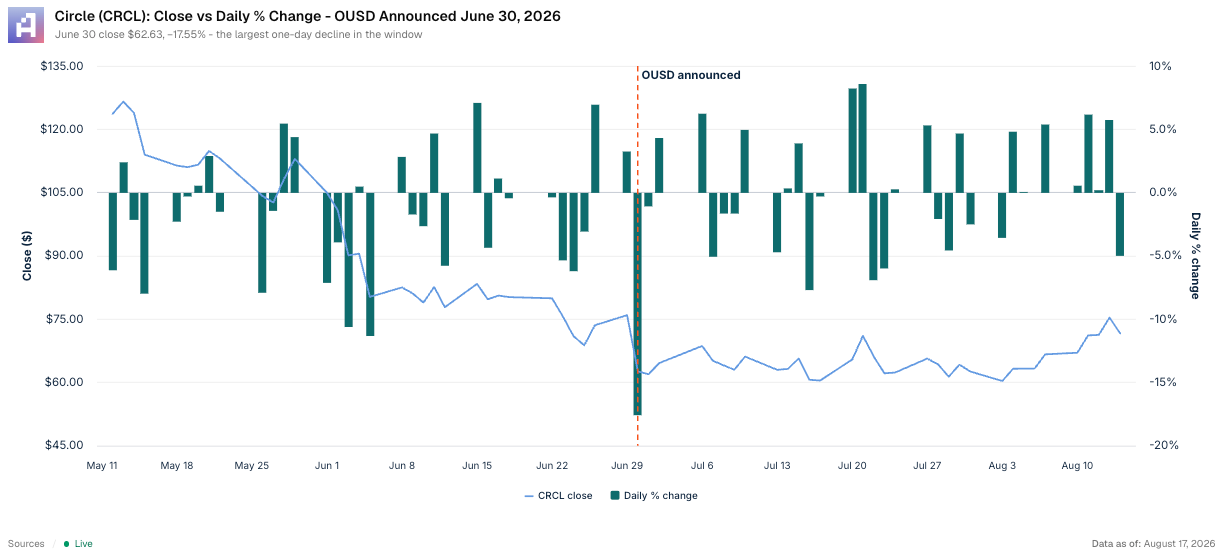
Circle’s second-worst trading day ever came on the announcement of Open Standard, a consortium stablecoin backed by 140+ companies including the likes of Stripe, Visa, Mastercard, and Google, to name a few. The stock dropped 17% on the news. The market’s reaction was telling: Stripe is going to get the band together and take down the Circle/Tether duopoly, distributing stablecoin revenue proportionally among consortium members. The news drove CRCL price near its lowest point ever.
Stablecoin growth
We believe many investors don’t believe stablecoins will reach $1T by 2030. They’ll point to the stagnating growth of stablecoins. But for the first time ever, stablecoin supply has decoupled from crypto prices. While crypto is down 50-70% from recent highs, stablecoin supply has remained flat, indicating that it is now a category of its own. If stablecoin supply continues to grow at its trailing 3 year growth rate, global supply will reach above $1T by 2030E.
The stablecoin market is winner-takes-most and liquidity/network effects are paramount
Over the past several years, tens of issuers have tried to dismantle the Circle/Tether duopoly. In spite of the hundreds of stablecoins now being issued, the two giants maintain over 80% share of supply. The first mover advantages gained by these players are really hard to overcome. Liquidity across chains, apps and exchanges is very hard to bootstrap, and Circle is already light years ahead of challengers.
On OUSD specifically: the market clearly thinks OUSD is a major threat to Circle’s business. Yet, history shows that consortia rarely succeed. A successful consortium needs:
Aligned incentives among members — OUSD has this to an extent via interest revenue distribution
Clear governance — Open Standard seems to be weak here, with several announcement “partners” revealing they were not consulted and remain non-committal
Existential pressure — I would argue most institutions don’t see stablecoins as existential quite yet, though Stripe maybe does
So Open Standard has ~1/3 requirements based on today’s information.
Circle is being priced as a stablecoin issuer instead of a full-stack money platform
The market views Circle as just the issuer of USDC. It discounts Circle’s revenue since it is almost entirely interest revenue at the whims of the Fed.
In reality, Circle is building a full stack money product for the future of the internet. It is a technology company at its core.
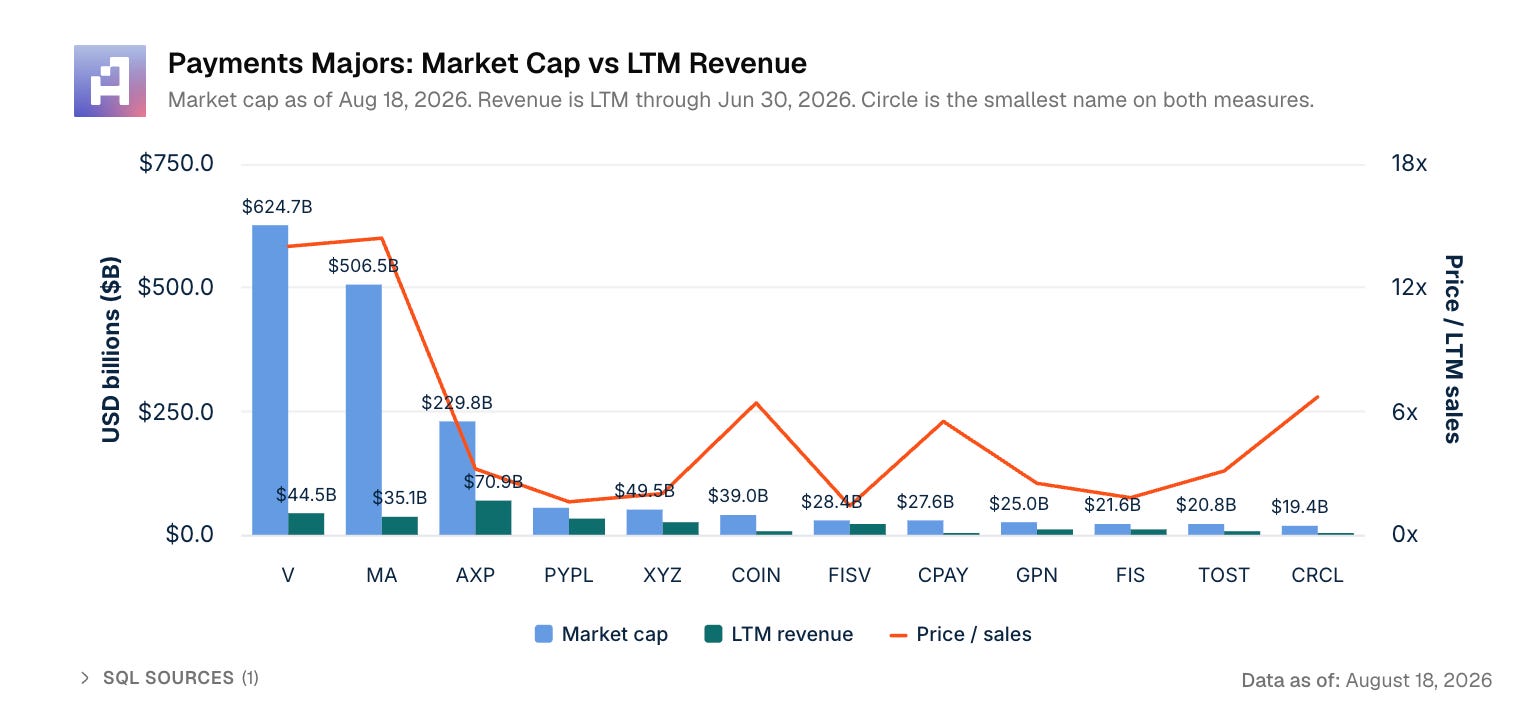
Circle valuation vs Payments peers. There is clearly a gap between the credit card networks and everyone else. If Circle builds out the next generation, full stack payments system, its market cap and valuation will more closely mirror the card networks, taking bps on turnover rather than float.
Envisioning a $50B Circle
Today, Circle run rates ~$2.8B in revenue and trades at an $18B val for a P/S of 6.7x, well below the payment networks (14x) and high growth fintech like HOOD (17x). It trades at nearly the exact same multiple as COIN, a stock viewed primarily as a crypto exchange.
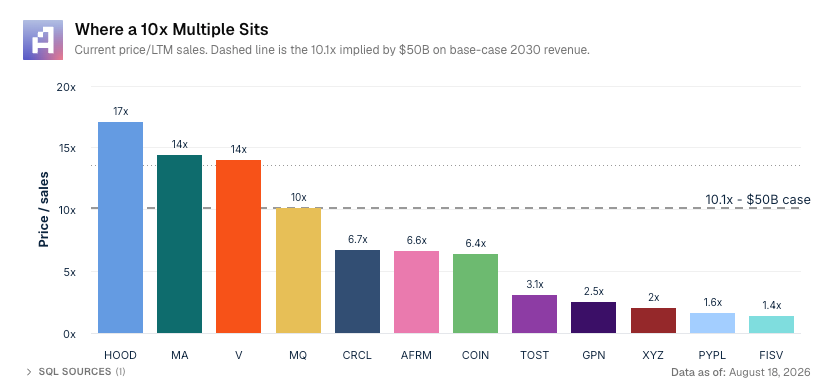
The market views Circle as a business that is pro-cyclical with crypto and whose revenue is rate-sensitive. Circle will outgrow both the label and the precarious revenues, allowing it to command a greater multiple — 10x is conservative and fair.
If predictions are correct, and liquidity/network effects are strong moats as we assume, in a 2030 with stablecoin supply at $1T, USDC share at 20% and rates at 2%, CRCL is poised to print $4B in interest revenue.
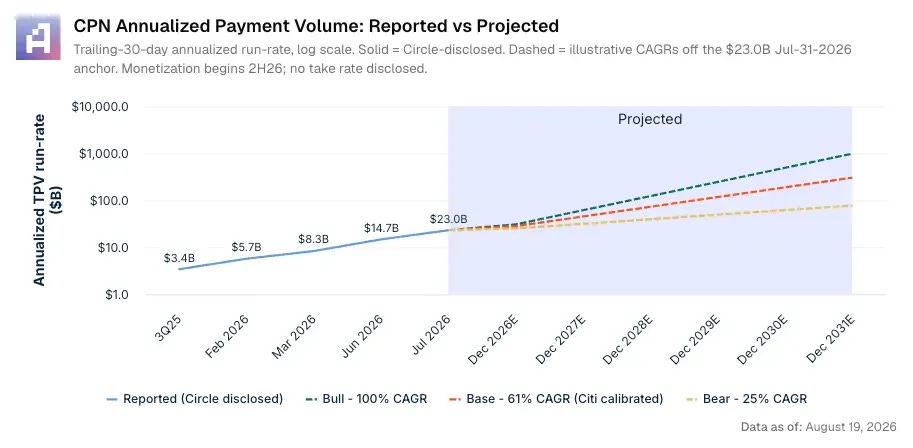
On revenue diversification, Circle is beginning to see traction in key growth products like Circle Payments Network. In spite of crypto prices remaining suppressed and stablecoin supply flat, volume on Circle Payments Network has grown at an explosive rate, $23B annualized as of the latest disclosure in late July 2026 — 6.8x growth YoY (off an admittedly small base), and 70% MoM. If growth remains high at a CAGR of 60-65%, volume would reach about $200B by 2030. At a 20bps take rate, that would generate an incremental $400M in revenue.
Looking to Arc chain, in the case it reaches the same scale as Tron (another stablecoin focused chain), Arc will generate $0.5B in fees.
The estimates above put CRCL near $5B in revenue, with 20% coming from growing payments/settlement related business lines, a combination which investors could understandably value at a higher multiple. With revenue growth and multiple expansion above we get $5B * 10 = $50B. The case for a $50B CRCL is not far fetched.
Well done Wes!!
Great work Alex!