

Market Overview
Risk assets round-tripped through the week. Bitcoin and ether had already been beaten down in early June as the US-Iran war and the threat to the Strait of Hormuz drove crypto into full risk-off, with bitcoin erasing all gains made since the start of the war and sliding below its pre-war levels around June 4. Sentiment then flipped: by June 16 both bitcoin and ether posted their strongest opening levels in about two weeks following news that the US and Iran were making meaningful strides toward a peace deal that would reopen the Strait of Hormuz, and as of June 17 bitcoin and ether were up 6.4% and 9.3% respectively versus a week earlier. The rally faded into Friday: the Fed under new Chair Kevin Warsh left rates unchanged on June 17 and signaled rate cuts are all but off the table for 2026, and a strengthening dollar pressured crypto, gold and silver lower, with bitcoin opening near $62,900 on June 19, down 2.4% on the day.
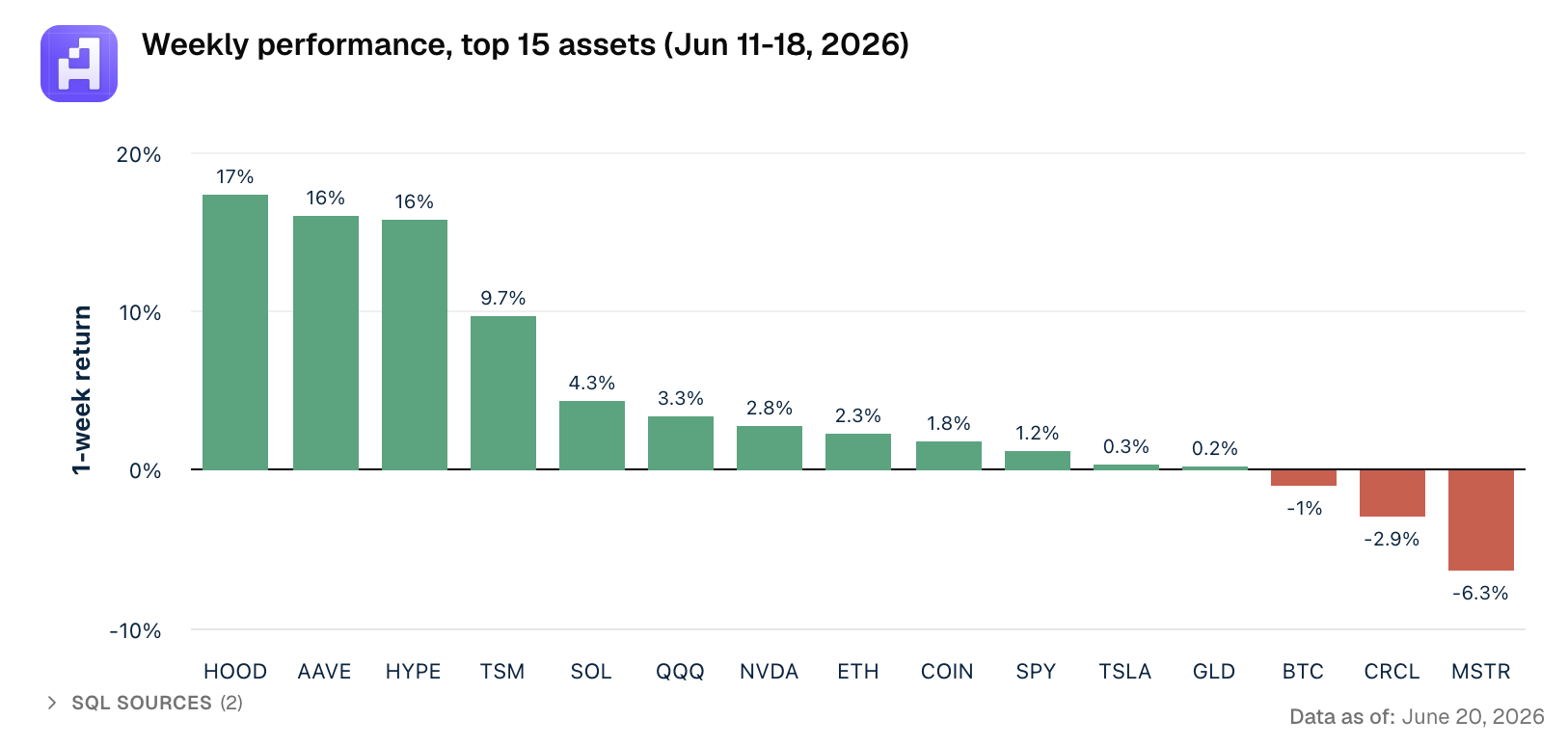
Brokers and DeFi led: HOOD (+17.3%), AAVE (+16.0%) and HYPE (+15.7%) topped the table, while MSTR (-6.3%), CRCL (-2.9%) and BTC (-1.0%) lagged. AI/semis were firm (TSM +9.7%, NVDA +2.8%, QQQ +3.3%) and gold was flat (GLD +0.2%) as the post-Fed dollar bid capped it.
Today We Highlight:
SpaceX drives Pre-IPO trading; popular pre-IPO market Ventuals sunsets
Canton announces $355 raise to grow its institutional-grade blockchain
Strategy’s STRC 0.00%↑ is in the midst of its worst depeg ever
SpaceX goes public, and Hyperliquid ran the unofficial IPO
The month’s marquee event: SpaceX sold roughly 555.6 million Class A shares at $135, raising about $75 billion at a ~$1.75 trillion valuation, marking the largest IPO in history. Its valuation is enough to make it roughly the seventh-largest US company, just above Tesla.
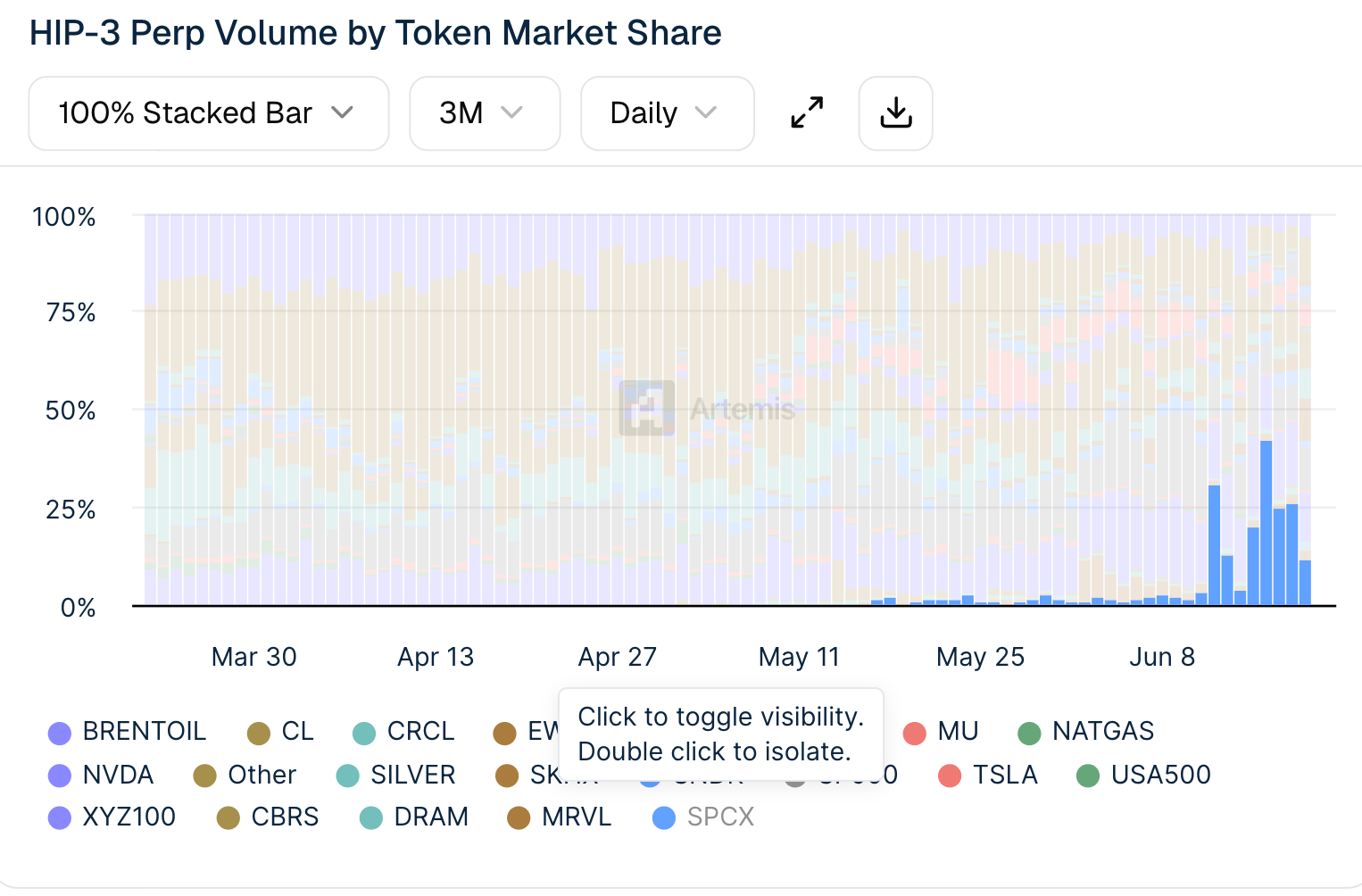
This year, a new class of market has been driving price discovery ahead of IPOs. Trade.xyz launched the SPCX-USDC pre-IPO perpetual on Hyperliquid on May 18 at a $150 reference price (a $1.78T implied valuation); it spiked to $216 within hours before settling at $202.89, up 12.7% on the day. By IPO week, SPCX accounted for roughly 30% of all HIP-3 trading volume on Hyperliquid, with aggregated open interest above $225M and more than $2.2B in cumulative volume. SPCX aggregated VWAP sat near $155, a 15% premium over the $135 IPO price, and printed near $172 on listing morning.
The pitch is that these synthetic markets price accurately: the earlier Cerebras pre-IPO perp closed within 3% of its Nasdaq open, versus ~35% spreads on traditional platforms, which is exactly the kind of performance that builds a reputation. Even NYSE/ICE chief Jeff Sprecher publicly called Hyperliquid “bigger than NASDAQ,” noting it’s run by just “11 people” (Coindesk).
The flip side of the pre-IPO boom is consolidation. Ventuals is the project behind the OpenAI and Anthropic perpetual markets on Hyperliquid, having facilitated over $650M in trading volume. On June 15 it is winding down and that its team will join another project building within the Hyperliquid ecosystem, and the team framed it as “one leg of the journey ends, and a new one begins”. Ventuals was one of the go-to markets for getting exposure to the equity of major private AI labs like OpenAI and Anthropic.
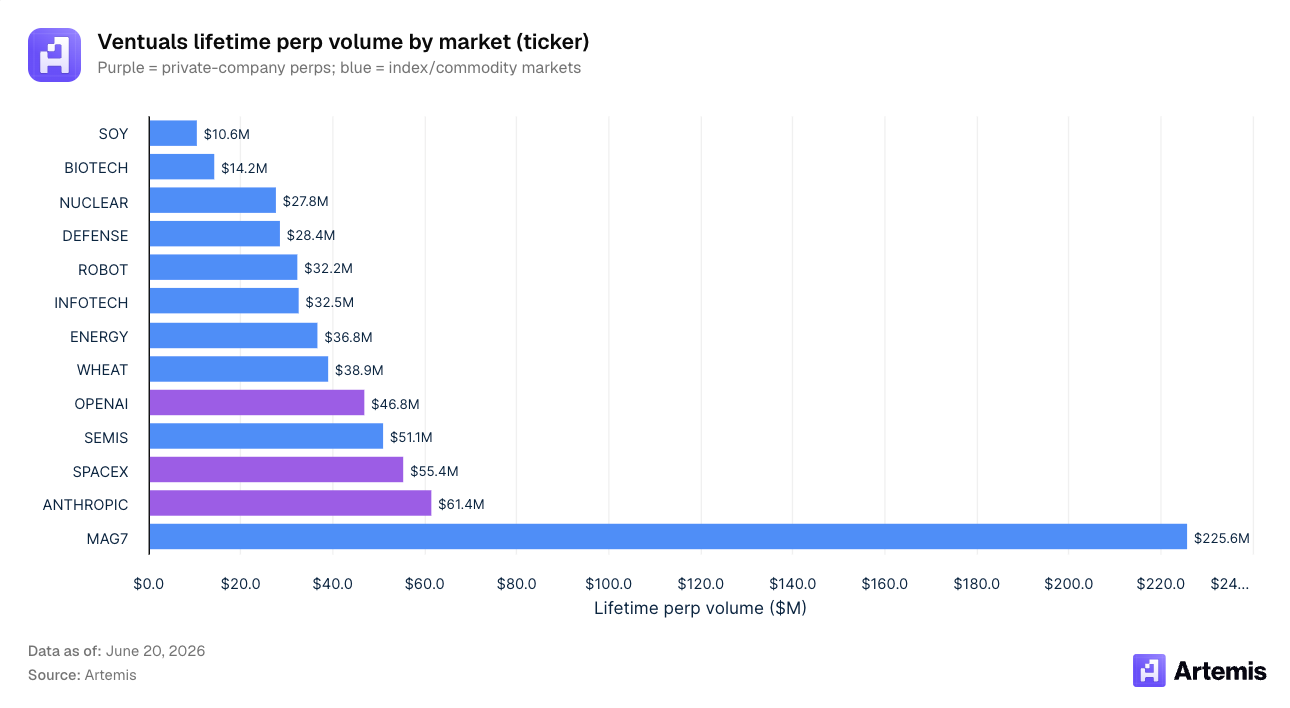
Ventuals went out having proven the demand: it generated more than $650 million in trading volume and raised over 500,000 HYPE through its vHYPE staking mechanism. The team also confirmed the points and referral programs are discontinued and that no Ventuals token will launch, since the wind-down removes any path to a value-accruing token. The bigger signal: TradeXYZ now accounts for nearly 97% of HIP-3 trading volume, making it the dominant operator in the category. For context on scale, Hyperliquid processed roughly $234 billion in perpetual futures volume over the past month.
Canton lands a $355M+ round as Wall Street picks an institutional chain
Digital Asset, the creator of the Canton Network, announced on June 11 a $355 million round led by a16z crypto, with participation from ABN Amro, the Abu Dhabi Investment Authority, Apollo, BNP Paribas, Citadel Securities, CME Ventures, Coinbase Ventures, HSBC, S&P Global, Tradeweb, Optiver and more than 20 other institutions. The round closed above an earlier $300 million target at a ~$2 billion valuation, and follows roughly $185 million raised over the prior 12 months (a $135M DRW/Tradeweb round in June 2025 and a $50M BNY/Nasdaq/S&P/iCapital extension in December 2025). a16z itself contributed about $100 million.
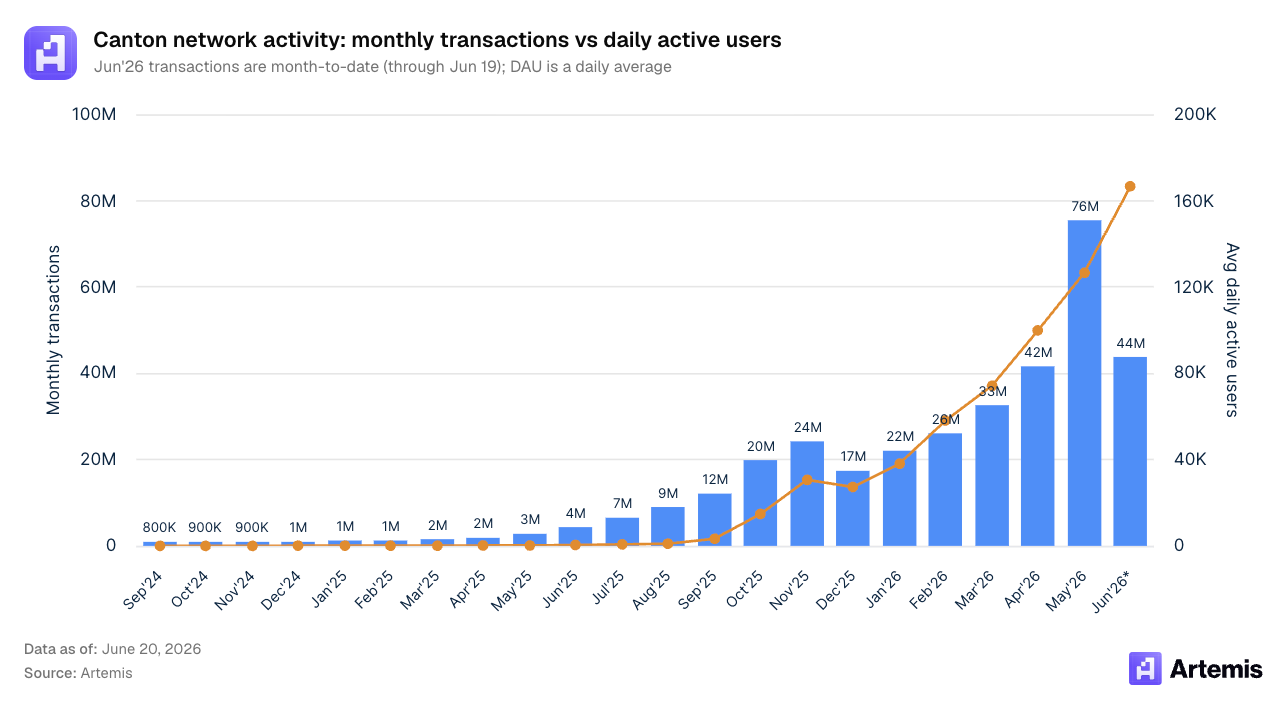
Canton is a public, permissionless Layer 1 with configurable privacy built for institutional finance, using Digital Asset’s Daml smart-contract language to enable tokenized-asset workflows while keeping transaction data confidential and the network now has more than 700 ecosystem participants. The raise lands in a heating institutional-chain race. It comes just after a16z closed a $2.2 billion fifth crypto fund, and alongside peers Stripe/Paradigm’s Tempo (reportedly $500M at a $5B valuation) and Circle’s Arc ($222M at a $3B valuation). Not everyone’s convinced: TD analyst Lance Vitanza has called Canton “a glorified database in the cloud” that isn’t consistent with bitcoin’s open, trustless, permissionless architecture.
Strategy’s STRC “Stretch” preferred breaks its peg
STRC, one of Strategy’s preferred equity instruments, traded this week near $82, 18% lower than its $100 par value. In our equities data, STRC sat pinned at a flat $100 through mid-April, last closed at par in mid-May, and has slid steadily since - ending June 18 at $88.59.
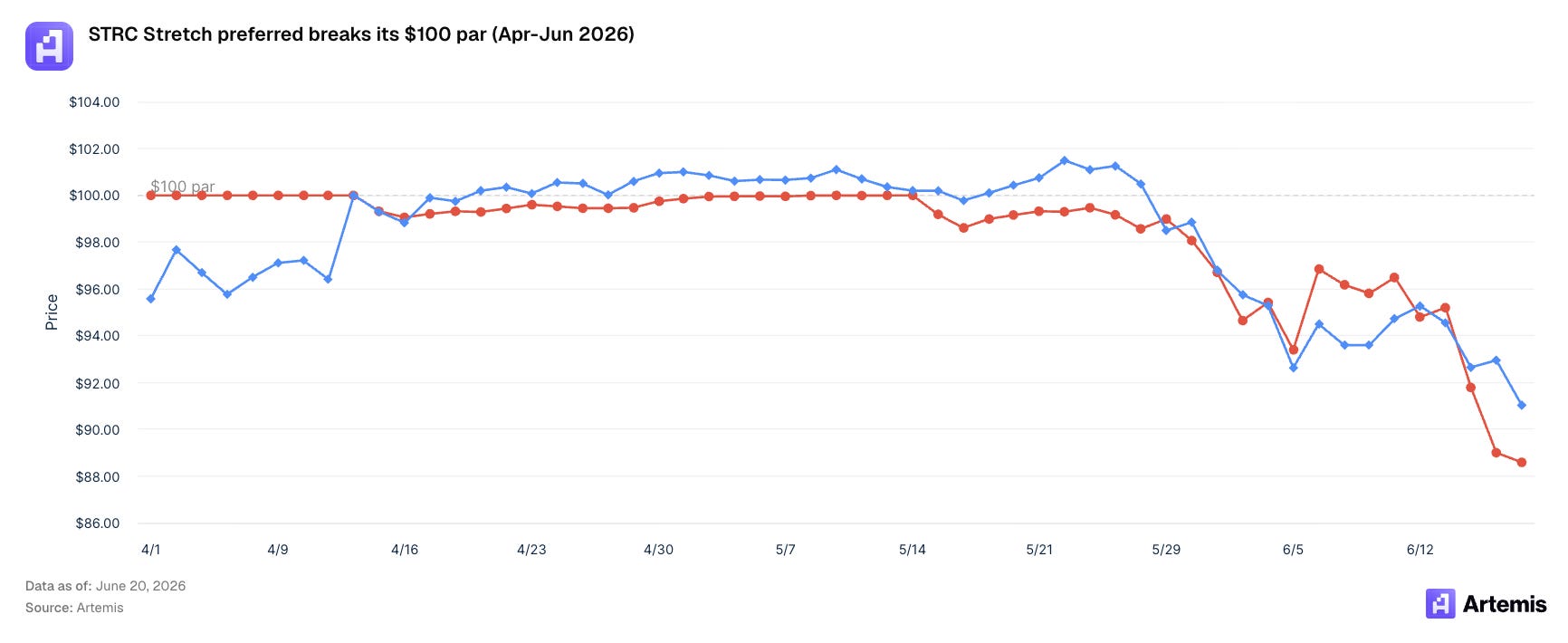
STRC is the centerpiece of Strategy’s funding machine. When it trades at or above $100, Strategy issues fresh STRC through an at-the-market (ATM) program and uses the proceeds to buy bitcoin; below par that channel becomes uneconomic, and the company has paused it. So the depeg directly throttles one of Saylor’s main levers for accumulating BTC.
The slide is partly self-inflicted: to fund STRC distributions, Strategy sold 32 bitcoin for about $2.5M in late May. This marked its first BTC sale since it began accumulating in 2022, rattling a market unused to Strategy ever being a seller. STRC then broke below $95 on June 3, which under Strategy’s February dividend framework triggers a recommended rate hike of at least 0.5% (~$53M/year of added cost). The dividend has been held at 11.5% for four straight months but is now widely expected to rise to at least 11.75% at the June 30 reset, and STRC is shifting to twice-monthly payments (first record date June 30, first payment July 15) in a bid to “stabilize price, dampen cyclicality, drive liquidity, and grow demand” (Strategy).
Strategy held 846,842 BTC as of June 14 - it bought 1,587 BTC (~$100M) that week, funded by $209M of common-stock ATM sales rather than STRC - but its legacy software business generates only ~$477M of annual revenue against more than $1.2B in preferred-dividend obligations, a gap bridged almost entirely by capital markets. STRC isn’t alone: the sibling $100-par STRF also sits below par (~$91), and rival Strive’s SATA preferred slipped under par too, prompting a move to daily dividends. Bears (Peter Schiff) are circling; bulls like Jesse Myers frame it as a leverage-driven liquidation cascade rather than a Terra/Luna-style break, arguing the fundamentals are unchanged and a June 30 dividend hike stabilizes it. This is a sobering reminder that a 12%-yielding “par” instrument is not a stablecoin. A few options present themselves to Strategy: sell BTC, sell MSTR, or skip STRC dividend payments. All eyes remain on Bitcoin’s largest treasury vehicle through this period of market tumult.
Charts of the Week
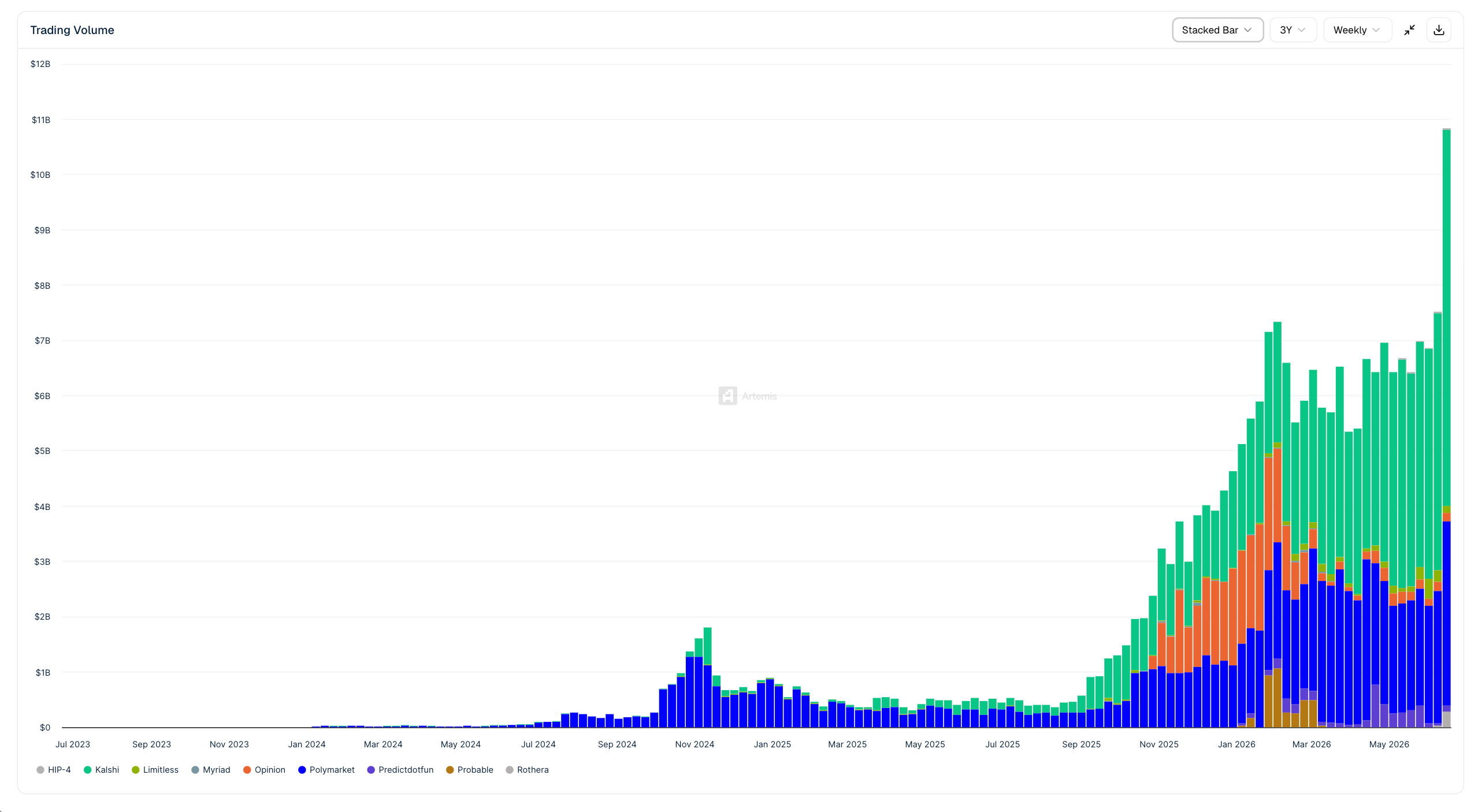
Prediction markets trading volume rockets past $10B driven by World Cup mania and the New York Knicks first NBA Championship win in 53 years
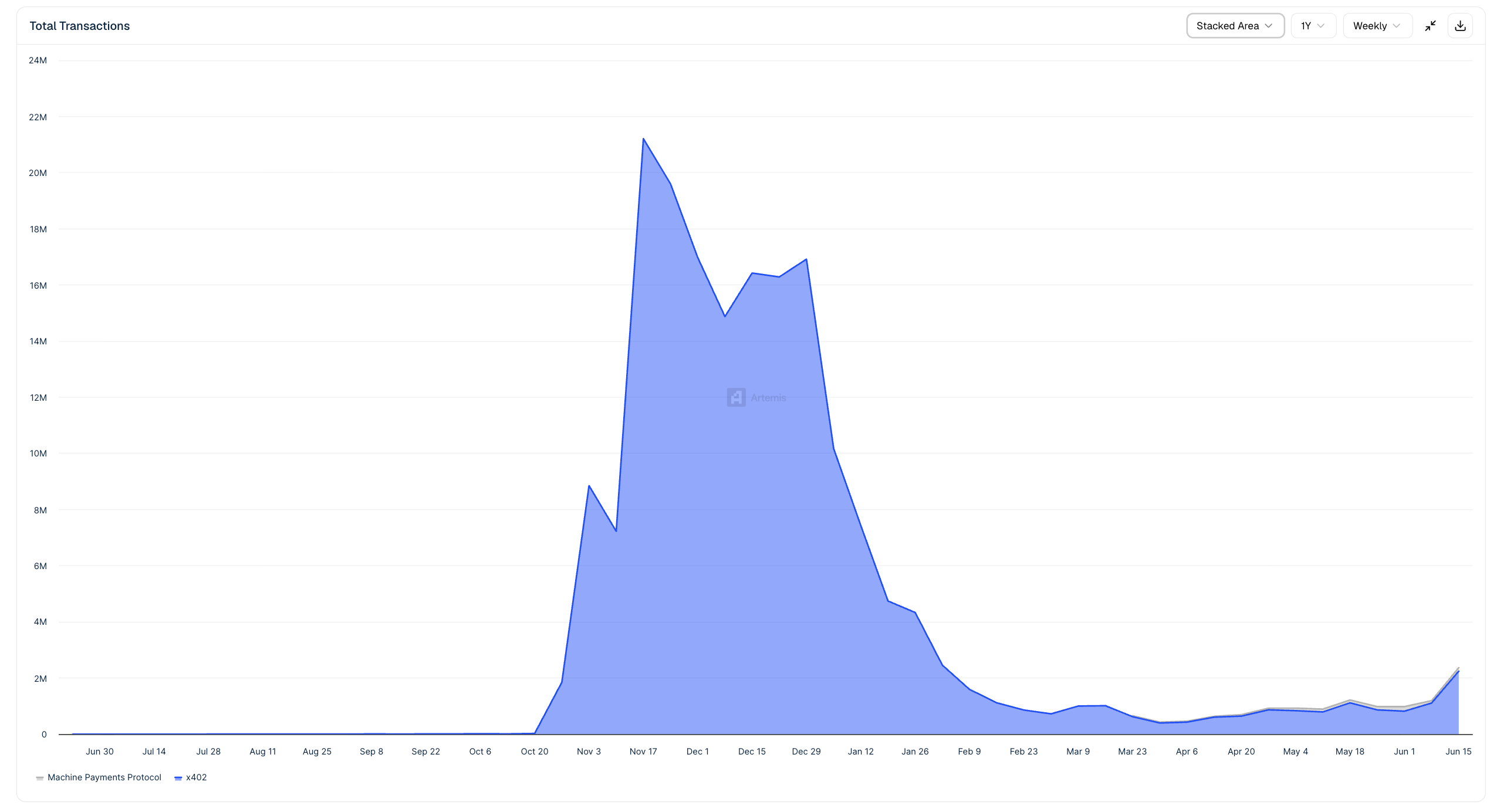
Agentic payments have begun to inflect
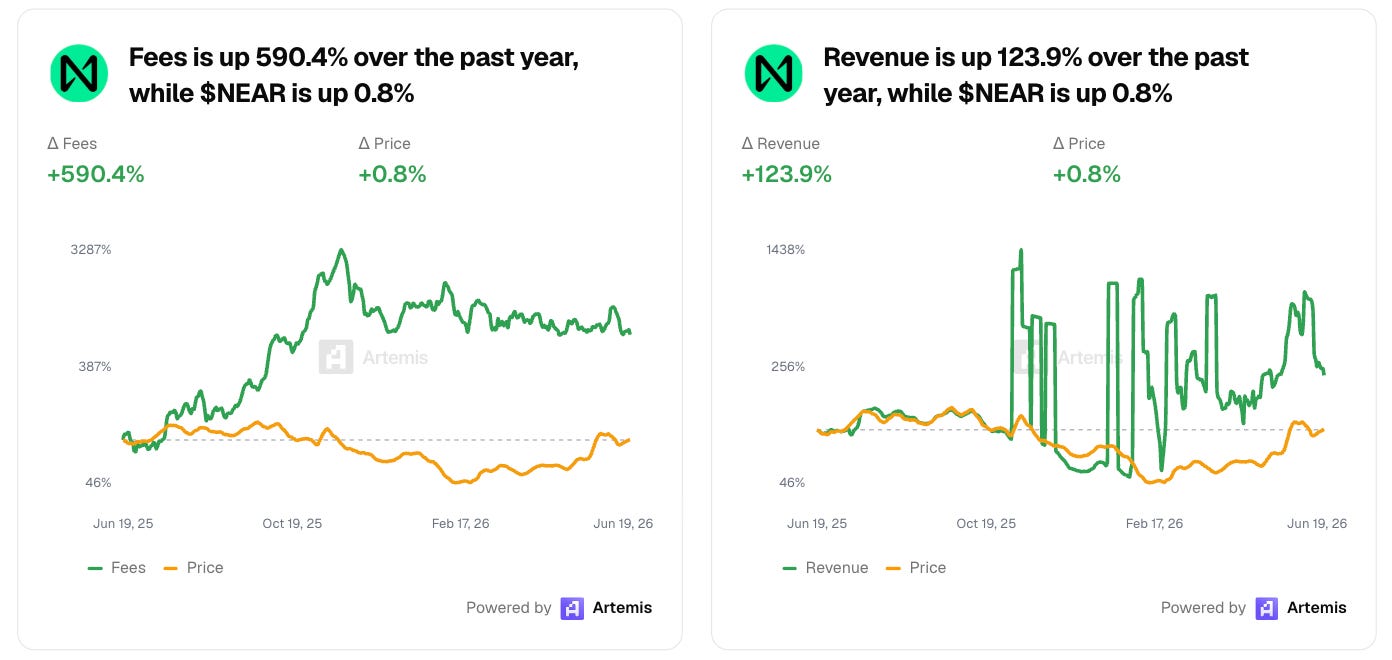
NEAR Fundamentals have held strong amid mediocre price performance
Other Notable News
Zelle steps into the remittance game with its own stablecoin (American Banker)
Charles Schwab is looking to break into the prediction market space (WSJ)
The Ethereum Foundation lost another leader as co-executive director Hsiao-Wei Wang resigned, following co-executive director Tomasz Stanczak’s earlier exit (Coindesk)
Thanks for reading! Stay ahead this week by using the Artemis Terminal to pull the underlying data on any of the stories above (COIN segment revenue and pre-IPO perps volume, spot BTC ETF flows, HYPE fees and buybacks) or pull live numbers straight into your models with =ART() in Excel/Google Sheets.
Disclaimer: This newsletter is produced by Artemis for informational and educational purposes only. It does not constitute investment advice, a recommendation to buy or sell any security or digital asset, or an offer to provide advisory services. Artemis and its employees may hold positions in assets discussed. Figures are accurate to the best of our knowledge as of publication; markets move quickly.