

Market Overview: The Weekly Recap
Market Sentiment: risk-off. The week kicked off on the back foot with a hot April CPI print on May 12 (3.8% YoY, hottest since May 2023) and a record $635M single-day BTC ETF outflow on May 13. Kevin Warsh was confirmed as the next Fed Chair (May 13) and the Senate Banking Committee advanced the CLARITY Act 15-9 (May 14). Bitwise’s spot Hyperliquid ETF (BHYP) began trading on NYSE on May 15.
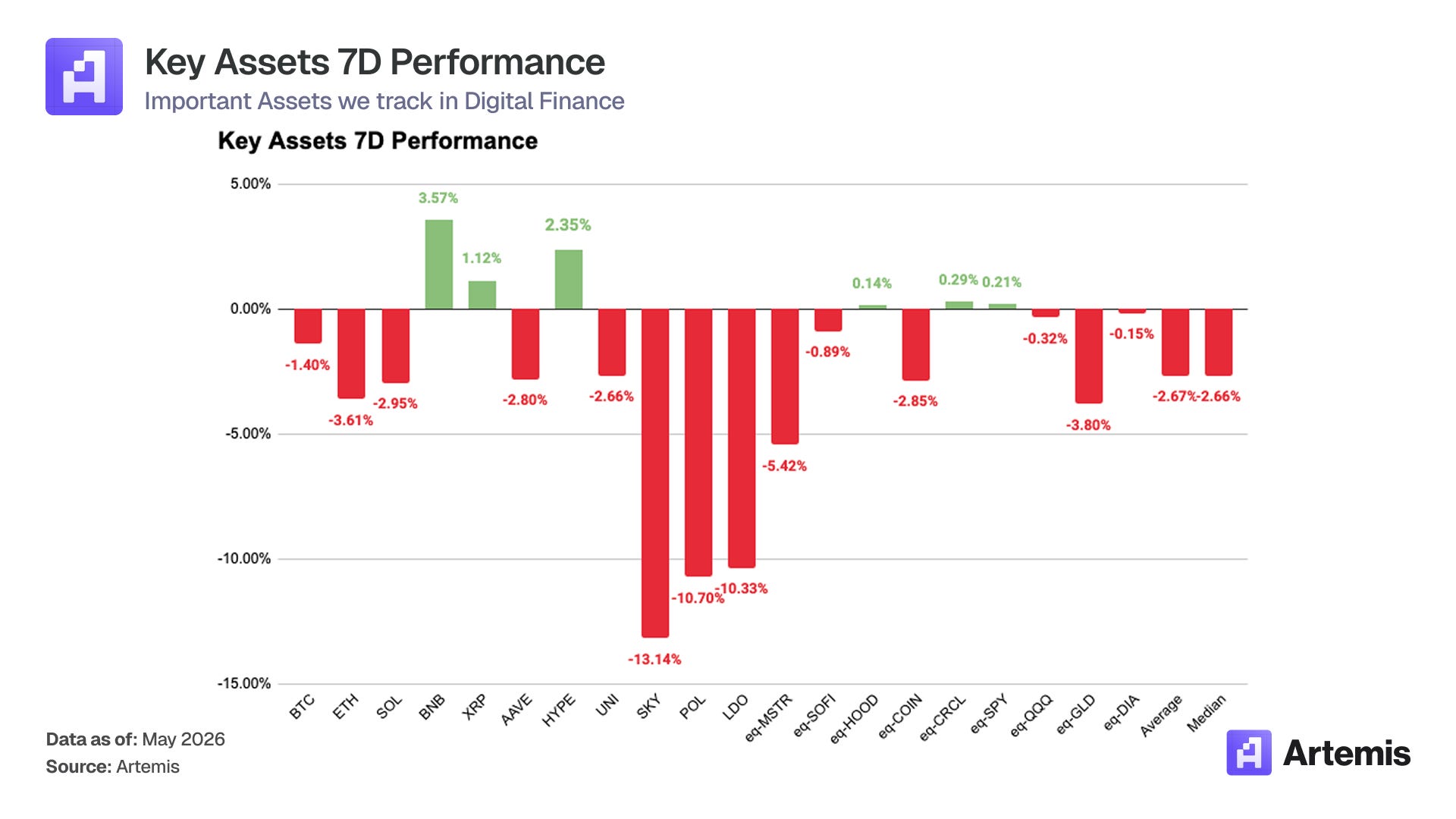
Across the digital finance basket, the week averaged -2.67% (median -2.66%). Green prints were sparse: BNB +3.57%, HYPE +2.35% (riding the BHYP tailwind), XRP +1.12% (CLARITY read-through), CRCL +0.29%, and HOOD +0.14%. The majors all closed lower: BTC -1.40%, ETH -3.61%, SOL -2.95%. The heaviest hits landed in DeFi: SKY -13.14%, POL -10.70% as Polymarket's chain-migration overhang kept pressing, and LDO -10.33% giving back the prior-week buyback rally. On the equity side, MSTR -5.42% led the decliners after a $12.54B Q1 GAAP loss and the smallest weekly BTC buy of 2026. Traditional indices weren't immune: SPY +0.21%, QQQ -0.32%, DIA -0.15%. Even GLD slipped -3.80%, taking some shine off the safe-haven trade.
Today We Highlight
CLARITY Act clears Senate Banking
Artemis Research Spotlight: COIN 0.00%↑
Bullish buys Equiniti for $4.2B
Coinbase becomes Hyperliquid's official USDC deployer
1. CLARITY Act clears Senate Banking
The Senate Banking Committee advanced the Digital Asset Market Clarity Act 15-9 on May 14. The vote was largely along party lines, with Democratic Senators Ruben Gallego (AZ) and Angela Alsobrooks (MD) joining all Republicans on the panel. Sen. Elizabeth Warren called it “a bill written by the crypto industry for the crypto industry,” but the bipartisan crossover is the structurally important read: it's the first time material Democratic support has materialized for a market-structure bill in committee.
What the bill does: classifies digital assets as securities or commodities and establishes formal SEC-CFTC jurisdiction lines. The SEC retains issuance and primary-market oversight; the CFTC takes secondary-market activity in non-security digital commodities. The framework operationalizes the SEC-CFTC MOU signed by Atkins and Selig on March 11 and the joint interpretation issued March 17.
Where it goes next: the bill heads to the Senate floor where it will be merged with the Agriculture Committee version. The 60-vote threshold means Republicans need ~5-7 more Democrats than the committee delivered. The legislative window is narrow: the August recess and the 2026 midterms compress the calendar.
Market reaction: XRP led on the print, briefly clearing $1.47 resistance before settling near $1.43. SOL and AAVE held bids better than ETH on the framing that both clear as commodities under the bill, removing a long-tail regulatory overhang. The BTC reaction was muted (BTC is already treated as a commodity), but the broader read-through is that altcoin beta finally has a structural rationale that isn't ETF approval. If the Senate gets to a floor vote by July, we'd expect the largest re-rate to land in tokens with active SEC litigation history.
2. Artemis Research Spotlight: COIN 0.00%↑
Artemis Research Spotlight: Why Coinbase wins in an AI-native finance world by Alex Weseley, Jon Ma, and Andrew Van Aken.
Artemis’s bull case argues Coinbase is mispriced as a cyclical crypto brokerage when it’s actually building the settlement, distribution, and commerce layer for AI-native finance. Target: $300B market cap by 2031 (~6x current, ~35% CAGR).
The thesis rests on two generational tailwinds the market is underweighting:
Stablecoins
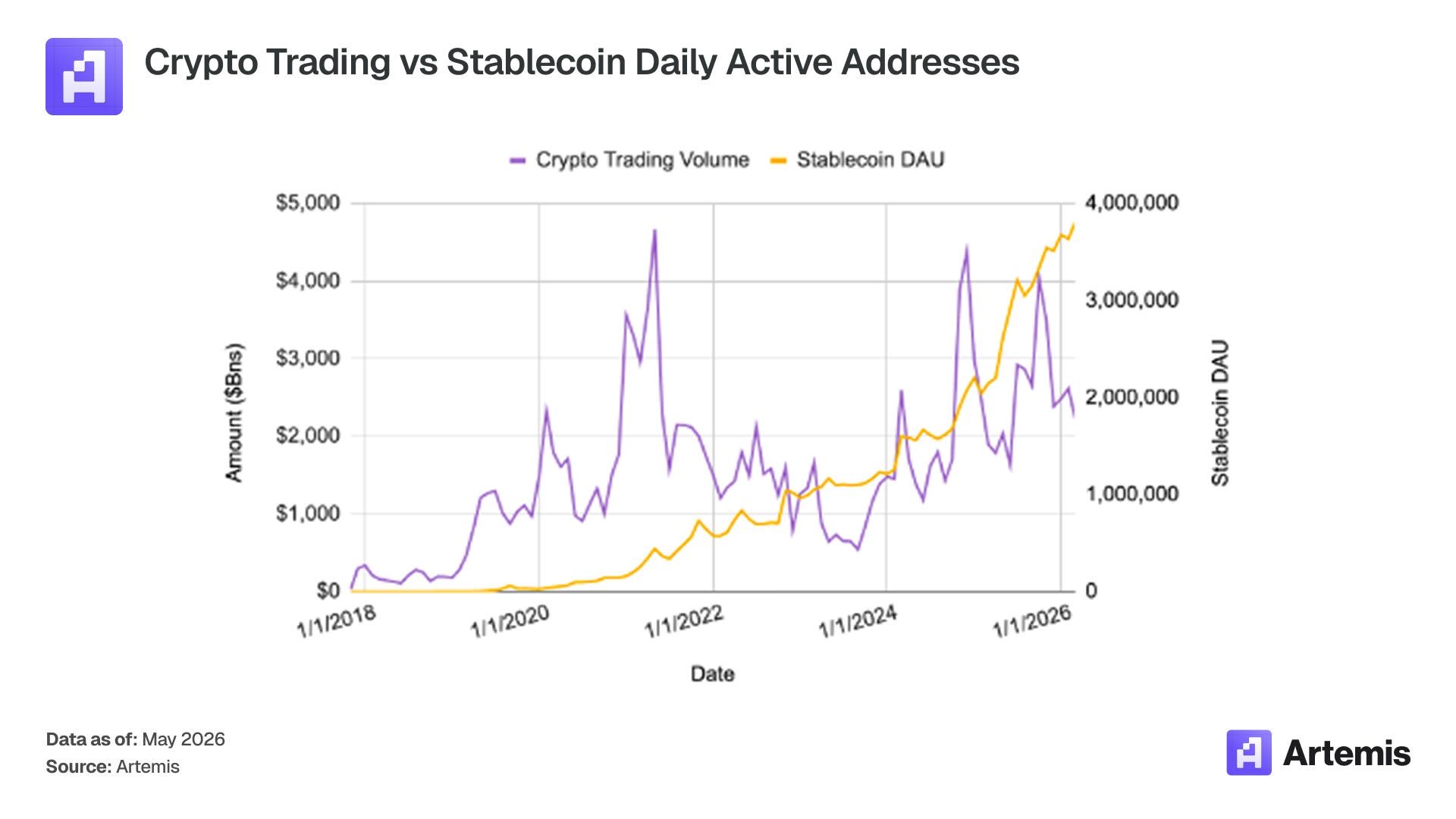
The USDC distribution agreement with Circle is structurally a Coinbase asset, not Circle’s. Coinbase’s share of Circle’s reserve revenue has climbed from 32% in 2022 to ~50% in each of the last two years, earning ~100% yield on USDC held in its products plus a share of off-platform balances via the Payment Base waterfall (Q4’25 average USDC in Coinbase products: $17.8B, an all-time high). Critically, the contract is a “continuation lock”: it auto-renews if Product/Company/Reseller thresholds are met, and per filings cannot be terminated if they are. With Bessent forecasting $3T stablecoin supply by 2030 (Bain says $3.8T), this is durable infrastructure revenue, not at-risk consumer product.
Agentic commerce
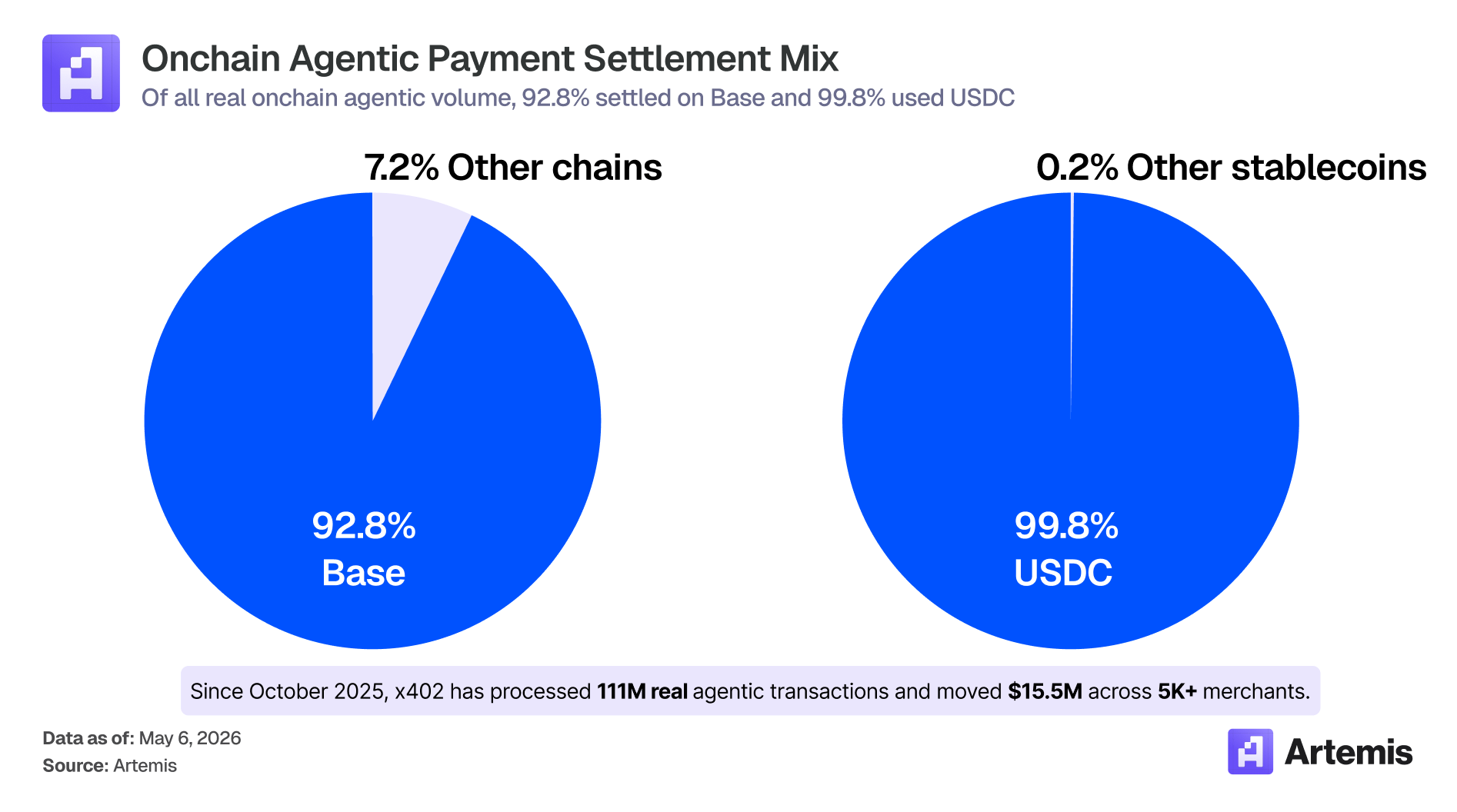
The onchain data is decisive: 92.8% of agentic payment volume runs on Base, 99.8% settles in USDC, and 99.8% transits x402 (Coinbase-pioneered, now managed by Linux Foundation). Since October 2025, x402 has processed 180M+ payments, $47.5M of agent spend, across 5K+ merchants. Card rails can’t economically handle sub-cent API calls; stablecoins on L2s can. McKinsey calls $3-5T global agentic commerce by 2030; Gartner says $15T B2B via agents by 2028.
Bull-case math: assuming $5T agentic commerce by 2030 with ~20% settling in stablecoins, Coinbase captures ~$5B in agentic revenue across three lines: USDC float (~$4B from $200B × 4% × 50% share), CDP/AgentKit/Agentic.Market ($750M), and Base sequencer fees ($250M).
Link to the full article here.
3. Bullish buys Equiniti for $4.2B
Bullish (BLSH) announced on May 5 that it has agreed to acquire transfer agent Equiniti from private-equity firm Siris Capital for $4.2B. The consideration is $1.85B of assumed debt and $2.35B of Bullish stock, priced at $38.48/share based on the 30-day VWAP through May 4. Close is expected in early 2027 pending regulatory approval.
What Equiniti brings: nearly 3,000 issuer clients, 15,000 corporate clients, 20M shareholders, and ~$500B in annual payments processed. Pro-forma 2026E adjusted revenue is ~$1.3B and adjusted EBITDA-less-capex is over $500M. Bullish guides 6-8% annual revenue growth from 2027E-2029E with $100M+ of incremental EBITDA-less-capex per year.
Strategic read: the deal positions Bullish as the first crypto-native operator with a regulated transfer agent attached. In a market where the SEC has been quiet on tokenized public equities, owning the registry layer means Bullish can offer real-time cap tables, automated corporate actions, and tokenized share liquidity, particularly for non-U.S. investors, without renting that infrastructure from incumbents. It's an explicit bet that tokenization moves through the back-office stack before it shows up in front-end products.
Context vs. Robinhood: HOOD has gone the front-end route (tokenized SpaceX and OpenAI exposure offered to EU investors). Bullish is buying the plumbing. Both bets converge on the same end state: if the SEC ever blesses tokenized public equities in the U.S., the firm that owns the transfer-agent rail captures economics from both sides of the trade.
4. Coinbase becomes Hyperliquid's official USDC deployer
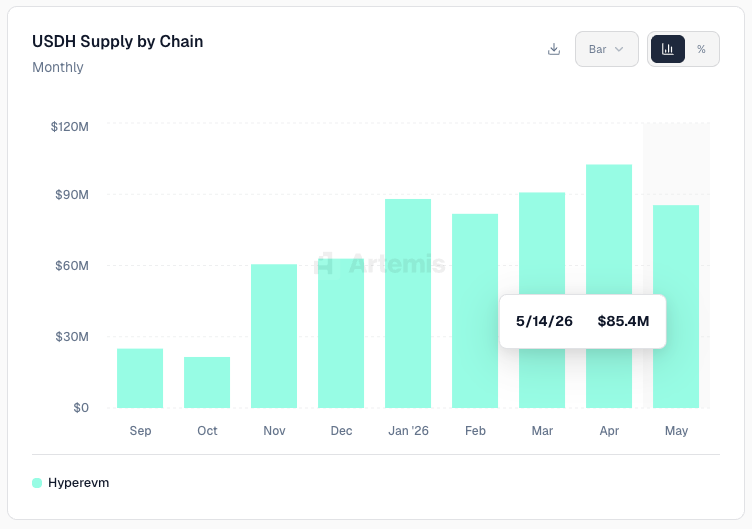
On May 14, Native Markets transferred the USDH brand assets to Coinbase, which became the official USDC treasury deployer on Hyperliquid. Circle takes the technical role for minting, redemption, and cross-chain transfers, and disclosed it will stake 500,000 HYPE (adding to a position established in September 2025) as it moves toward becoming a Hyperliquid validator. USDH remains redeemable for USDC or fiat during the migration period before being phased out.
Why this matters: USDC supply on Hyperliquid has roughly doubled YoY to ~$5B. By formalizing Coinbase as the deployer and Circle as the rails operator, Hyperliquid effectively converts its largest stablecoin float into a fee-and-treasury relationship with the two most regulated U.S. crypto entities. It also removes a clear regulatory tail risk for HYPE: a native stablecoin issued by a no-KYC perps exchange was always an audit-and-compliance question; an offshore-issued USDC stack with Coinbase managing treasury isn't.
Read on HYPE: the move is incremental cash flow to the Assistance Fund (the fee economics flow through buyback-and-burn) and a step toward institutional distribution. Combined with the Friday BHYP launch (the first U.S. spot HYPE ETF with staking), the chain now has a regulated wrapper on the equity side, a regulated stablecoin on the rails side, and the most efficient perps order book in the market.
The bull case from the April Hyperliquid Strategies ($PURR) deep dive looks materially closer to base case after this week.
Charts of the Week
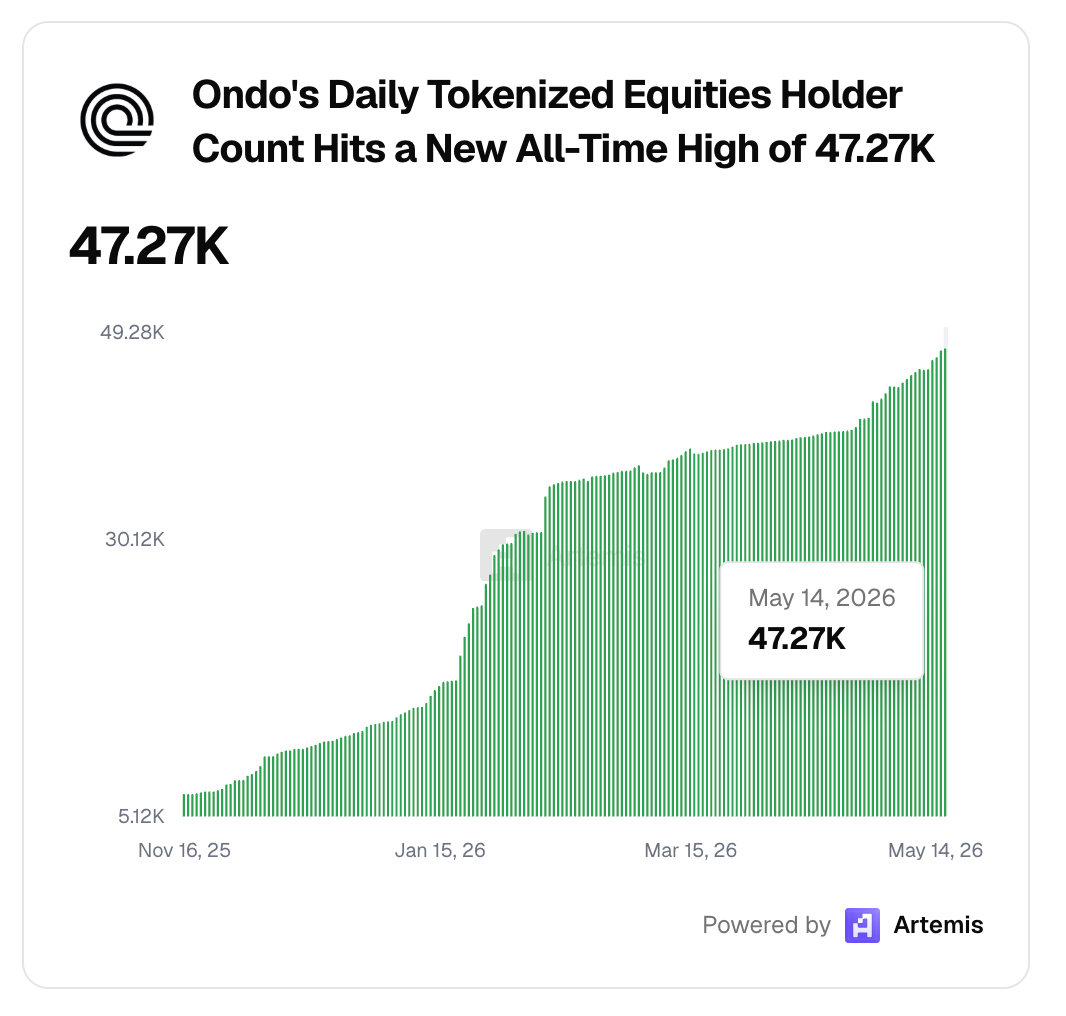
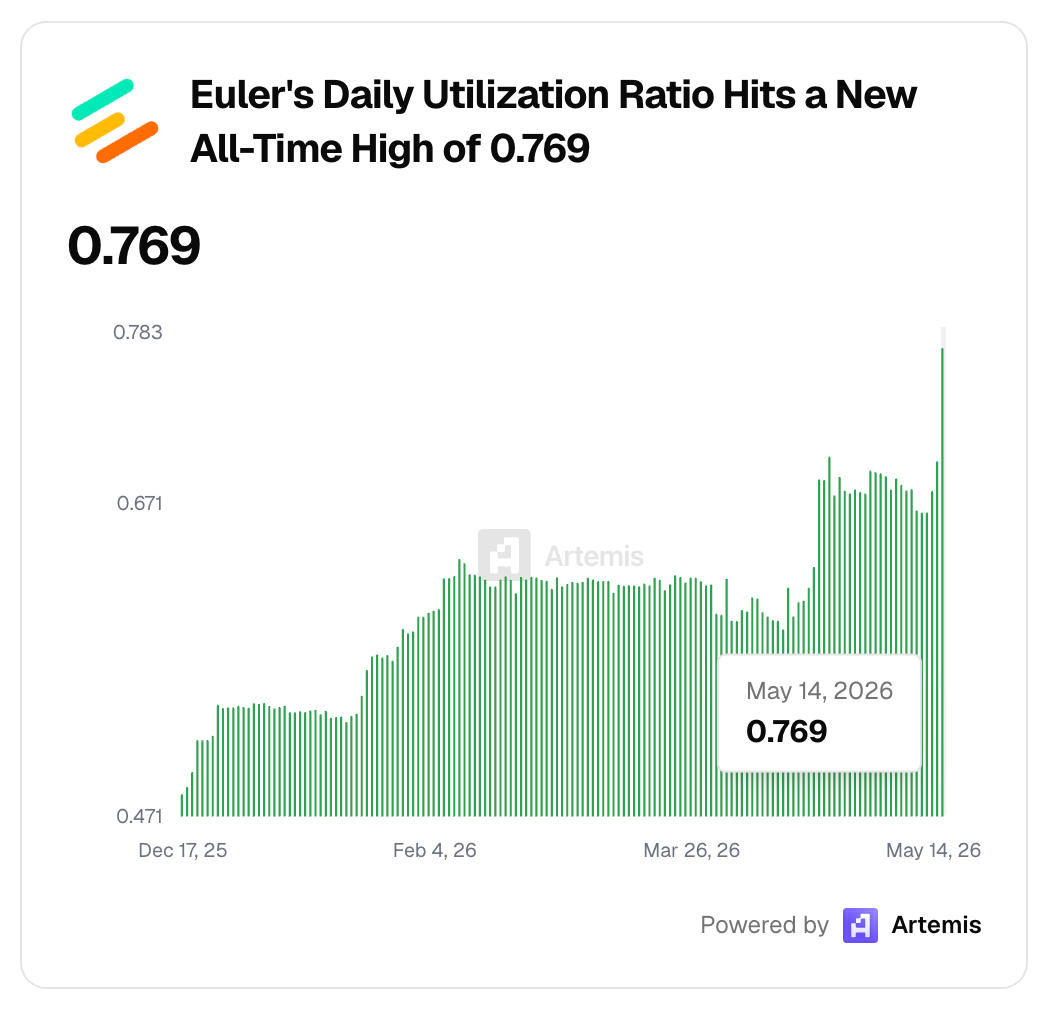
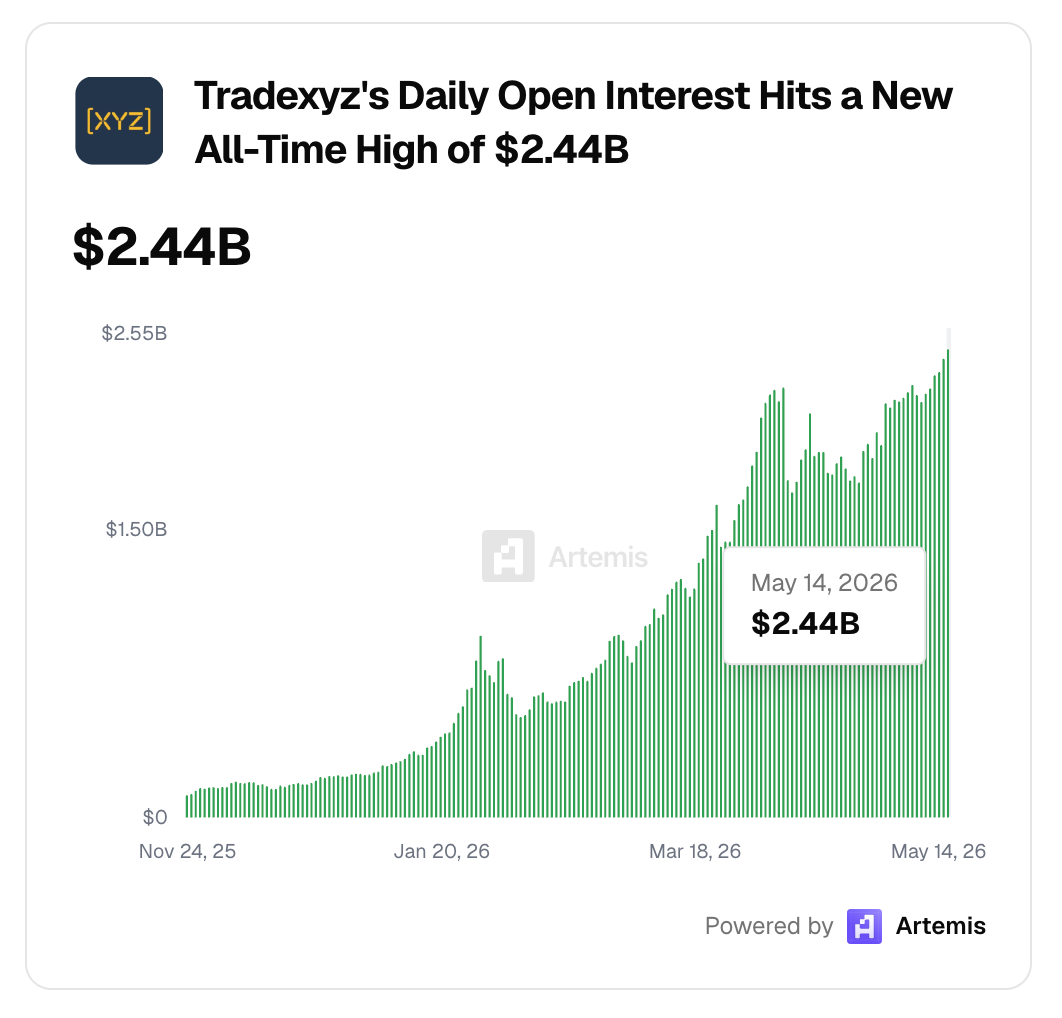
Other Notable News
Coinbase (COIN) reported Q1’26 on May 7: revenue $1.41B (vs. $1.52B est.), GAAP EPS -$1.49 on a $482M crypto markdown, adjusted EBITDA $303.3M. Transaction revenue -23% QoQ to $756M, subscription $583.5M, derivatives volume $4.2B (+169% YoY), all-time high 8.6% global crypto trading market share.
Strategy (MSTR) reported Q1’26 on May 5: revenue $124.3M (+11.9% YoY), net loss of $12.54B driven by BTC fair-value markdown, BTC Yield 9.4% YTD, holdings 818,334. The May 5-11 weekly buy was just 535 BTC for $43M at $80,340/coin, the smallest weekly purchase of 2026. CEO Phong Le and Saylor for the first time disclosed conditions under which they would sell BTC (dividend funding and tax management when sales beat new equity issuance).
Circle (CRCL) reported Q1’26 on May 11: revenue $694M (+20% YoY), adjusted EBITDA $151M (+24%), net income $55M (-15% YoY), USDC supply $77B, onchain transaction volume +263% YoY to $21.5T. Closed the Arc token presale ($222M raised at $3B FDV, a16z crypto leading). CRCL +16% on the print.
Western Union launched USDPT on Solana May 4, issued by Anchorage Digital Bank. First MSB-distributed regulated stablecoin built for remittance corridors; “Stable by Western Union” consumer product slated for 40+ countries later in 2026.
Bitwise BHYP began NYSE trading May 15. The first U.S. spot Hyperliquid ETF, and the first U.S. crypto ETF with in-house staking. 0.34% sponsor fee, waived to 0% for the first month on the first $500M of AUM.
Thanks for reading! Stay ahead this week by using the Artemis Terminal to pull the underlying data on any of the stories above (CLARITY Act vote tracker, COIN Q1 segment revenue, USDC supply on Hyperliquid) or pull live numbers straight into your models with =ART() in Excel.
Disclaimer: This newsletter is produced by Artemis for informational and educational purposes only. It does not constitute investment advice, a recommendation to buy or sell any security or digital asset, or an offer to provide advisory services. Artemis and its employees may hold positions in assets discussed. Figures are accurate to the best of our knowledge as of publication; markets move quickly.
Hi Jon Ma,
Came across Artemis Big Fundamentals and really appreciate the depth of insights you share across markets and crypto.
I write about fintech, crypto infrastructure, stablecoins, and the broader evolution of financial systems. I’ve also subscribed to your work and would genuinely like to stay connected and support each other’s writing and research.
Would be great to connect and exchange ideas as both of us explore similar spaces from different angles.