

On August 5, 2026, Figma (NYSE: FIG 0.00%↑) reported its Q2’26 earnings report. Here’s a quick recap:
Revenue was $370.1 million (up 48% yoy)
Net Dollar Retention Rate was 136%
GAAP gross profit was $309.6 million; GAAP gross margin was 84%
GAAP net loss was $(112.2) million, driven by SBC: $147.6 million
15,964 Paid Customers with more than $10k in ARR (up 34% yoy)
1,635 Paid Customers with more than $100k in ARR (up 46% yoy)
The numbers were strong yet, Figma fell 17% after earnings. I got curious about what happened and went down a deep rabbit hole.
I started thinking and realised there is a much bigger possibility for Figma:
I believe Figma will become the design layer for ALL creators and agents building software.
Before AI, the workflow was pretty straightforward:
Designer → Figma → Engineer → Code → Software
Now, the workflow starts to look more like:
Designer / Engineer / PM / Product Engineer / Agent
↓
Figma / Design System
↓
Software
Here are three things which support my thesis.
1. The rise of Product Engineers
The term “product engineers” was popularized through people such as Sherif Mansour, Jean-Michel Lemieux and Gergely Orosz, who helped shape how we think about the role today.
So, what is a product engineer?
A product engineer is someone who writes code, understands customer pain points, and helps shape the product.
AI makes software easier to build. As the cost of writing code falls, engineers are taking on more work across product and design. These boundaries are starting to blur.
I think this matters for Figma because engineering teams have historically been much larger than design teams. One of Figma’s largest customers now holds more seats for engineers than designers, and this will become more common in the future.
I got curious about on whether people are searching for “product engineer”. Google trends tells me what I have imagined. This term has been picked up meaningfully over the past few years.
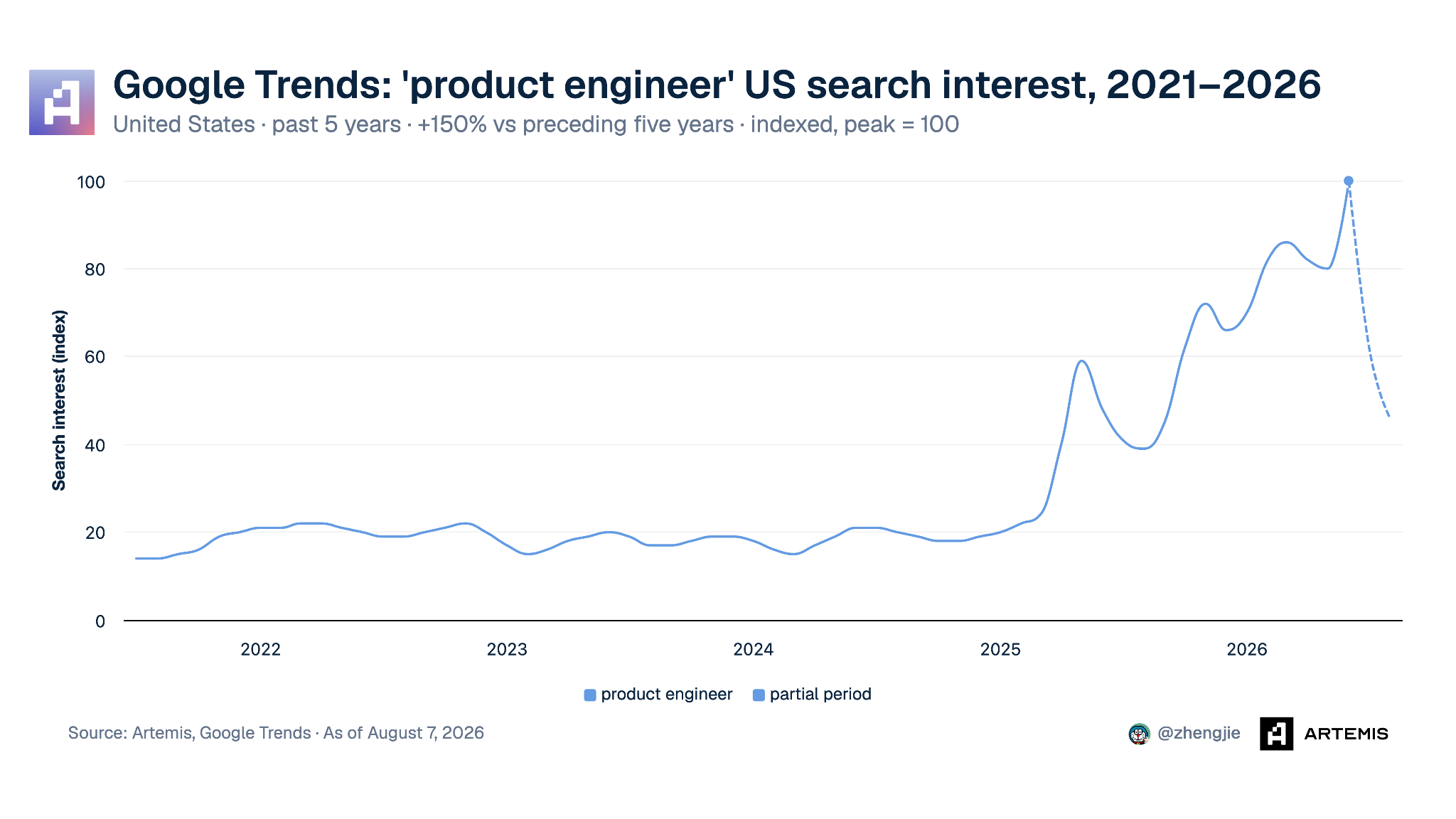
If this trend continues, I believe product engineers will be one of the key growth drivers for Figma.
2. Every Employee will have an Agent (Figma Agent)
In 2026, everyone is talking about agents, agents, agents. The next expansion for Figma will be from humans to agents.
Traditional SaaS monetization is simple:
Cost Per Seat ✕ No. of Seats
I believe in an agentic world, every employee will have one or multiple agents working on their behalf. These agents will help to iterate (edits a component, turn a mockup into code) on products. These actions will naturally consume inference and compute.
And this is how SaaS business model will be in the future:
(Cost Per Seats ✕ No. of Seats) + (Credits Consumed ✕ Cost Per Credit)
I believe that Figma will continue to monetize people (seats) using their products and also the work being done through them (the agents).
3. Margins Expansion
AI is expensive. Compute and inference are cost to every business that wants to enable AI.
As Figma launched Figma Make, gross margins fell from 90% to 80% as inference became part of the cost of revenue. In Q2 ‘26, non-GAAP gross margin recovered to 85% as Figma began monetizing AI usage through credits.
What I (and everyone on the street) thought will be a cost to Figma, becomes an additional revenue stream.
I truly believe that as Figma continues to monetize their suite of AI products (Figma Make, Figma Agent, Figma Weave and Figma MCP), their margins will continue to expand.
Risks
AI Tools such as Claude/OpenAI will be able to replace Figma
The biggest risk to the thesis is that these AI tools, got so good that it will collapse the entire design-to-code workflow. If a user is able to describe in natural language how the look and feel of a product is and ship it end-to-end, Figma is probably cooked.
Mitigant: I think that is still far from the truth today (or anytime soon). Figma already owns the customers. Customers are familiar with the current tooling and have their workflows around it. Furthermore, many years of design systems are already embedded inside Figma which is a huge moat.
Why is the market mispricing this?
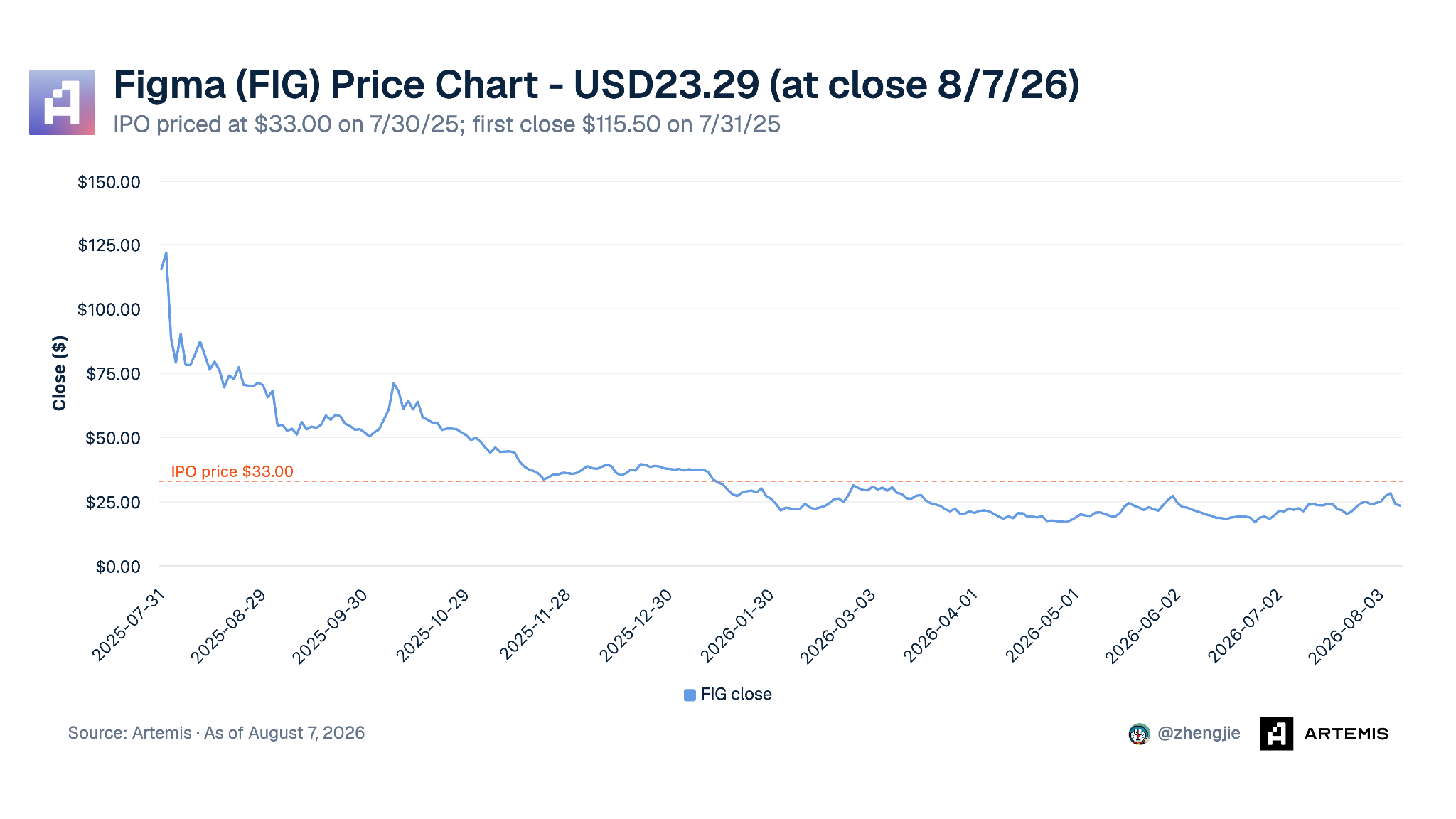
Figma stock price has been down 80% since the first closed ($115.50 on 7/31/2025).
In my view, three things suggest why Figma is mispriced:
Revenue in Q2 ’26 continues to grow 40% yoy (means people are still using Figma even with the implosion of Claude tools)
NRR (Net dollar Retention Rate) is at 136% (seats expansion still remains very high and market is very pessimistic about software stocks)
EV/ARR is trading near all time lows at 7.3x today (it is not cheap but given Figma’s growth rate, I feel it is reasonably priced)
Conclusion
The market still values Figma as a software company for designers.
I think that misses the bigger opportunity.
As the lines between roles continue to blur (the immersion of new roles: product engineers) and agents help in building software. Figma has THE opportunity to become the de facto design layer connecting all of them.
The bull case is no longer just more designers paying for more seats.
It is:
More creators using Figma,
More agents operating through Figma,
and more AI usage being monetized on top of it.
When that happens, Figma’s TAM will become significantly larger than what the market is pricing in today.
Canvas is more threatened by AI design frontier like Claude design capabilities than Figma imho. Why because Figma is for experts and canva not. Figma targets product team productivity and product engineering workflows while Canvas is used by non designer to create designed stuff like ads, presentation and other marketing stuff that are much less complex design wise. So by its positioning, persona and ai platform envelopment angles, Figma has more room to survive than say Canva.
I concur with the analysis, Figma is de facto the design system layer for AI development workflow. Also I use it to connect via MCP to all my AI agents to create a code design loop keeping design always up to date and shareable among different AI agents because it is AI agent agnostic. It also act as the guardrail of the design, branding and visual communication layer across all AI workflows including marketing and sales. Being agnostic, I think it is one of its strength.